


Negotiating steep descents, slick river stones, and rutted dirt paths places repetitive downward stress on ankles, knees, and hips. Hikers and everyday walkers often wonder what is the purpose of walking sticks when venturing across varied outdoor terrain. At its core, an outdoor staff or walking stick serves as an active extension of your upper body, transferring downward gravitational forces away from tired leg joints into your arms and shoulders. This single point of auxiliary ground contact creates a stable tripod with your lower limbs, helping you maintain upright posture and steady forward cadence across unpredictable footpaths.
Beyond relieving physical wear on sensitive joints, a dependable stick boosts balance confidence without the clinical aesthetic associated with traditional medical mobility devices. Whether pairing your outdoor gear with supportive trail pants for knee comfort or packing light for weekend nature paths, using a dedicated balance stick enhances ground awareness through tactile feedback. By learning how shaft flex, ergonomic grips, and specialized ground tips work together, outdoor enthusiasts can move with greater efficiency, reduce cumulative fatigue, and navigate loose soil or wet rock surfaces safely.

Pros
- Compact 13.4-inch folded size packs easily into daypacks, travel luggage, or side bottle sleeves
- Aircraft-grade 7075 aluminum alloy provides reliable strength against bending on rocky trails
- External Quick Lock mechanism allows simple height adjustments from 43.3 to 49.2 inches
- Grooved EVA foam handle absorbs hand sweat while maintaining a comfortable, non-slip grip
- Includes a durable tungsten steel tip with a protective rubber foot for varied surfaces
Cons
- Sold as a single pole (1 PC), meaning hikers who prefer dual-pole stability must purchase two units
- Maximum extended length of 49.2 inches may not suit taller hikers above 6 feet 2 inches
- Fixed adjustment range (43.3 to 49.2 inches) may be too long for individuals under 5 feet 3 inches
The A ALAFEN 7075 Aluminum Collapsible Trekking Pole is a single, folding walking stick designed for day hikers, backpackers, and travelers who require portable stability on the trail. Unlike standard telescoping poles that can remain awkwardly long when strapped to a backpack, this model folds down to a compact 13.4 inches. That manageable profile makes it especially suitable for hikers carrying mid-sized daypacks, overnight packs with external gear attachments, or travel bags where packing volume is limited.
Real-world trail utility centers on how easily the pole stows and deploys. Weighing approximately 0.6875 pounds (about 11 ounces), the pole adds very little base weight to your hiking pack. When assembled, its Quick Lock mechanism allows you to adjust the functional length between 43.3 inches and 49.2 inches. The pole shaft includes a printed measuring scale, which helps you quickly set your preferred height depending on whether you are climbing uphill or descending steep terrain. According to manufacturer specifications, this adjustment range accommodates hikers between 5 feet 3 inches and 6 feet 2 inches.
Construction quality centers on aircraft-grade 7075 aluminum alloy, a material well-regarded in the outdoor gear space for its resilience against bending and impact deformation. At the handle, an EVA foam grip features a skid-resistant grooved surface and sweat-absorbent texture to help maintain control during warm-weather hikes or strenuous ascents. The attached wrist strap adds stability and helps distribute grip pressure. For ground traction, the bottom houses a rugged tungsten steel tip that bites into packed dirt, mud, and scree, while an included rubber footing covers the metal tip for pavement or slick rock slabs.
Packing and trail-side handling are straightforward thanks to the multi-section folding design. When collapsed to 13.4 inches, the pole easily slips inside standard backpack main compartments, fits into tall side water bottle sleeves, or lashes onto external compression straps and trekking pole loops. Deploying the pole involves extending the connected segments until the internal tension cord locks in place, followed by securing the lever-action Quick Lock clamp at your desired height mark. Maintenance requires minimal effort, mainly consisting of wiping away trail grit, rinsing off mud, and allowing the sections to air dry completely before long-term storage.
Potential buyers should consider a few practical limitations before ordering. This listing includes only a single pole (1 PC), so hikers who rely on a dual-pole setup for knee relief or balance will need to purchase a second unit. Additionally, the adjustment range of 43.3 to 49.2 inches limits proper ergonomic fit for hikers under 5 feet 3 inches or taller than 6 feet 2 inches. While 7075 aluminum is durable and impact-resistant, it does weigh slightly more than high-end carbon fiber options, and the folding mechanism requires careful locking to prevent slippage under heavy downward force.
For hikers, campers, and travel enthusiasts seeking a reliable and budget-friendly single walking stick, the A ALAFEN collapsible pole delivers excellent practical value. Its ability to tuck neatly into or onto almost any hiking backpack makes it a hassle-free addition to your gear lineup. If you fall within the supported height range and want dependable trail support without the bulk of traditional full-length poles, this compact aluminum model is a sensible choice.
When fully collapsed, the A ALAFEN trekking pole measures 13.4 inches, making it short enough to fit inside most daypacks or slide into exterior side pockets without protruding excessively. This makes it far more pack-friendly than conventional three-section telescoping poles that typically collapse to 24 inches or more.
The working length adjusts from 43.3 inches (110 cm) to 49.2 inches (125 cm) using an external Quick Lock lever. The manufacturer lists a recommended user height range of 5 feet 3 inches to 6 feet 2 inches (160 cm to 187 cm). If your height falls outside this window, the pole may not provide an optimal 90-degree elbow angle on flat terrain.
The pole shaft is constructed from aircraft-grade 7075 aluminum alloy, offering solid structural resistance to bending forces common on rocky descents. The handle is shaped from grooved EVA foam designed to absorb hand moisture and reduce slippage during humid trail conditions.
The tip features a tungsten steel point engineered for firm penetration into dirt, gravel, and packed forest trails. A removable rubber foot is included to shield the metal tip and provide traction on asphalt, stone walkways, or slick granite slabs.
Pros
- Lightweight build at only 9.92 oz per pole reduces arm fatigue on long day hikes and backpacking trips
- Internal anti-shock springs help absorb repeated trail impacts on rocky or downhill terrain
- Includes full set of mud baskets, snow baskets, walking caps, and rubber tips for varied trail surfaces
- Disassembles down to 21.46 inches for practical packing inside standard 22-inch travel luggage
Cons
- Internal twist locks require firm manual tightening compared to external flick-lock levers
- Collapsed length of 25.6 inches may protrude above compact daypacks when lashed to external straps
- Rubber grips offer dependable traction but may feel less breathable on hot, sweaty summer hikes than natural cork
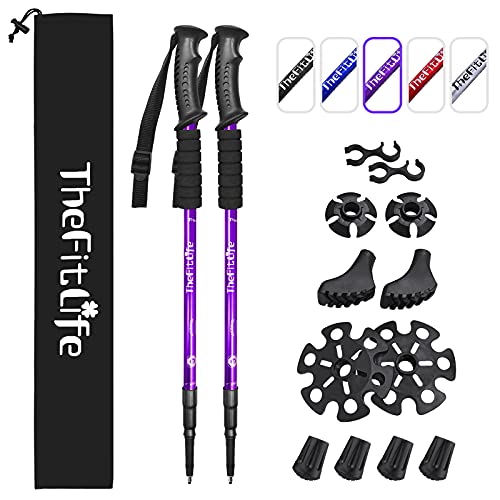
TheFitLife Telescopic Trekking Poles are adjustable three-section aluminum hiking sticks designed for day hikers, weekend backpackers, fitness walkers, and travelers who need reliable balance assistance on the trail. Weighing just 9.92 ounces (282 grams) per pole, this set adds minimal weight when strapped to a backpack while offering structural stability for ascending steep inclines and navigating uneven terrain.
Built to accommodate a broad range of user heights, each pole extends from 25.6 inches (65 cm) up to 51.2 inches (130 cm). The internal anti-shock spring system is engineered to dampen trail vibrations each time the pole plants on hard rock or packed dirt. This subtle cushioning effect is particularly helpful during long descents where repetitive shock transfers directly into the wrists, elbows, and knees.
The shafts are constructed from high-strength aluminum alloy, balancing impact resistance with fatigue durability on rocky paths. Rather than using external clamp levers that can catch on underbrush or gear webbing, TheFitLife utilizes a refined internal twist-lock system. It tightens securely with a simple twist, maintaining a streamlined profile that is easy to operate even while wearing trail gloves. Ergonomic non-slip rubber grips provide a firm and comfortable hold throughout changing weather.
Packing and trail transport are straightforward. Outdoor hikers can secure the poles externally using backpack gear loops and compression straps at their collapsed length of 25.6 inches. For travelers packing for distant trailheads, the poles separate completely into three sections measuring 21.46 inches (54.5 cm), allowing them to fit diagonally inside most standard 22-inch or larger travel suitcases. The package also includes mud baskets, snow baskets, protective rubber tips, and walking caps to handle mud, scree, snow, or paved paths.
A realistic consideration is the twist-lock design itself. While it eliminates bulky external hardware, twist mechanisms require deliberate tightening to prevent slipping under heavy vertical pressure, which can be harder to gauge in freezing weather compared to quick-cam levers. Additionally, hikers using small daypacks under 20 liters may find the 25.6-inch collapsed length slightly tall when mounted to smaller exterior pack pockets.
For recreational day hikers, entry-level backpackers, and fitness walkers seeking reliable trail support at a budget-conscious price point, TheFitLife Telescopic Trekking Poles offer strong value. Their combination of joint-cushioning anti-shock springs, solid aluminum durability, and comprehensive seasonal attachments makes them a versatile companion for trails across the country.
TheFitLife Trekking Poles offer a versatile length adjustment range spanning from 25.6 inches (65 cm) to 51.2 inches (130 cm). This broad range allows men, women, teenagers, and seniors to set an optimal pole height that maintains an efficient 90-degree elbow bend on flat terrain.
Height adjustments are controlled by twisting the telescoping sections. Hikers can shorten the shafts during steep uphill climbs to maintain forward momentum or lengthen them on descents to improve balance and stability across rough trail sections.
When hiking with a daypack or backpacking pack, these poles can be secured externally to trekking-pole loops, daisy chains, or side compression straps. Their collapsed profile of 25.6 inches sits comfortably alongside standard 30 to 65-liter backpacks without excessive overhang.
For air travel or off-season storage, the three aluminum sections can be separated entirely. In this disassembled state, the longest section measures 21.46 inches (54.5 cm), making the set compact enough to fit diagonally within most 22-inch or larger luggage bags.
TheFitLife provides a multi-terrain accessory kit with every pair. Included are rubber tips for hard rock surfaces, walking caps designed for paved surfaces and fitness walking, mud baskets to prevent poles from sinking into soft soil, and broader snow baskets for winter trail use.
All included attachments screw on and off quickly in the field without tools. This modular system allows hikers to adapt the poles seamlessly whether navigating muddy spring switchbacks or paved park trails.
The Functional Mechanics and Practical Purpose of Walking Sticks
A walking stick serves primarily as an auxiliary stability aid, a biomechanical shock absorber, and an active probe for unpredictable terrain. By establishing an additional point of contact with the ground, a walking stick redistributes gravitational load across your upper body, steadies your center of mass, and significantly reduces the cumulative impact absorbed by your lower limbs. Whether navigating steep backcountry switchbacks, pacing along packed gravel greenways, or managing minor knee discomfort, incorporating a dedicated staff transforms your natural walking gait into a balanced four-point or three-point movement pattern. Understanding these biomechanical functions clarifies why hikers, recreational walkers, and outdoor travelers rely on walking sticks for safety and endurance.
Biomechanical Joint Offloading and Downhill Deceleration
Descending steep outdoor grades places immense eccentric stress on the quadriceps and patellar tendons. Each downhill step forces the forward knee to decelerate your entire body weight, which rapidly amplifies joint strain and accelerates leg muscle fatigue. Planting a walking stick slightly ahead of your lead foot allows your triceps, pectorals, and core musculature to absorb a substantial portion of that downward kinetic energy. This deliberate transfer of force spares delicate cartilage in the knees and hips, helping you maintain controlled footing rather than collapsing into heavy, jarring footsteps.
The mechanical benefits extend directly into the lumbar spine and lower back. When hiking without upper-body support, carrying a daypack or leaning back against a steep slope can hyperextend your lower back and create chronic muscular tightness. A supportive shaft acts as a steady brake, allowing you to descend with an upright, neutral pelvic alignment. Some modern alloy sticks even incorporate internal anti-shock springs that soften the initial strike against hard granite, dampening high-frequency vibrations before they reach your wrist, elbow, and shoulder joints.
Dynamic Balance Stabilization and Ground Contact Points
Human walking relies on a continuous cycle of shifting balance between two narrow feet, which leaves you vulnerable to sudden slips across loose gravel, wet leaves, or exposed tree roots. Introducing a walking stick creates an immediate tripod configuration, expanding your functional base of support over uneven ground. If one foot slides on loose scree, the planted stick provides immediate counter-leverage that prevents a minor stumble from developing into a painful fall. This mechanical redundancy proves invaluable when traversing narrow ridges or contouring along sloping hillsides.
Beyond structural support, a walking stick acts as an external sensory instrument that transmits real-time tactile information directly to your hands. By resting the tip ahead of your stride, you instantly gauge the firmness, stability, and slickness of the upcoming surface before committing your full body weight. This enhanced neuromuscular feedback reduces mental hesitation, allowing older adults and active hikers to move across irregular footpaths with steady rhythm and heightened balance confidence. It is worth noting, however, that recreational walking sticks are designed for balance assistance and are not certified clinical mobility aids or medical crutches.
Trail Probing, Obstacle Clearing, and Stream Navigation
Backcountry hiking paths frequently present hidden hazards that are difficult to evaluate with visual inspection alone. Hikers use the sturdy tip of a walking stick to probe deep puddles, test the consistency of thick mud, and confirm whether submerged stepping stones are slick with algae. During cold-weather outings, tapping the stick across frozen patches helps determine ice thickness and surface traction before stepping forward. This probing capability keeps your footwear dry, prevents unexpected sinkholes, and ensures safe footing across unpredictable wetlands.
A walking staff also doubles as an essential barrier tool for clearing outdoor obstacles. Walking through overgrown forest corridors often means encountering low-hanging brambles, stinging nettles, and thick spiderwebs strung across the trail at face level. Sweeping the stick gently ahead of your path clears these nuisances without forcing you to use bare hands or risk facial scratches. During shallow creek crossings, leaning firmly on the planted shaft against the water current provides crucial lateral bracing against moving water and slippery river cobbles.
Uphill Cadence, Posture Alignment, and Respiratory Efficiency
Ascending steep inclines demands significant cardiovascular effort and places heavy demands on the glutes, hamstrings, and calves. Utilizing a walking stick allows you to recruit powerful upper-body muscle groups, including the latissimus dorsi, anterior deltoids, and triceps, to assist your forward and upward momentum. By pushing down firmly on the stick handle with each upward step, your arms actively pull your torso upward, distributing metabolic workload evenly throughout the entire body. This integrated muscular engagement maintains steady climbing cadence and noticeably delays lower-body muscular exhaustion.
Climbing hills without hand support often causes hikers to round their shoulders and hunch their upper bodies forward, severely compressing the diaphragm. This hunched posture restricts full lung expansion, reducing oxygen intake precisely when your cardiovascular system requires maximum airflow. Holding a walking stick naturally encourages an upright chest and open shoulder posture, facilitating deep, rhythmic diaphragmatic breathing. The resulting improvement in oxygen exchange enhances endurance, allowing outdoor enthusiasts to climb long grades with less breathlessness.
Single Walking Staff Versus Dual Trekking Poles
Outdoor enthusiasts frequently debate the practical differences between carrying a single walking stick and using a pair of dedicated trekking poles. While dual poles excel at high-cadence Nordic walking and alpine backpacking on defined trails, a single walking staff provides unmatched freedom of movement and trail versatility. Carrying one stick keeps your opposite hand completely free to check a handheld GPS, grab a water bottle, manage dog leashes, or grasp tree branches when scrambling over large rocks. This free-hand convenience makes a single staff ideal for casual day hikes, nature photography, and neighborhood exercise walks.
A single walking stick also carries a timeless outdoor aesthetic that many active walkers prefer over clinical canes or technical twin-pole setups. Handcrafted hardwood staffs and sleek single alloy poles offer dignified, outdoor-inspired support that helps active adults maintain balance without feeling self-conscious. Furthermore, shifting a single stick between your left and right hands balances arm fatigue across long distances and allows you to position the support on whichever side faces downhill or requires greater lateral stability.
Height Sizing Principles for Posture and Joint Relief
Achieving the primary benefits of a walking stick depends heavily on establishing the correct shaft height. For standard fitness walking and level paths, the universal sizing standard requires standing upright in your regular walking shoes and adjusting the stick until your elbow forms a clean 90-degree angle with your forearm parallel to the ground. If the stick is positioned too high, your shoulder lifts awkwardly, leading to chronic trapezius tension and neck stiffness over long walks. Conversely, a stick that is too short forces you to stoop forward, compromising spinal alignment and worsening lower back fatigue.
Traditional single hiking staffs, however, often follow a taller sizing methodology that extends between 50 and 55 inches, reaching chest or shoulder height. This extended length allows walkers to shift their grip dynamically depending on terrain gradient. You can choke down lower on the grip during steep uphill climbs, hold the middle section on flat ground, and palm the top rounded knob when descending steep drops. Modern adjustable models, such as telescoping aluminum poles with smooth twist locks or quick-lock lever clamps, make it easy to dial in precise heights between 43 and 51 inches to match changing trail conditions.
Traction Hardware: Rubber Ferrules Versus Hardened Spikes
The functional versatility of any walking stick relies heavily on the specific tip hardware mounted at its base. Bare tungsten steel or carbide rod tips are engineered specifically for off-pavement performance, digging securely into hard-packed dirt, shale, woodland humus, and slick trail ice. However, bare metal tips present a severe slipping hazard if placed directly onto smooth granite slabs, paved asphalt, or finished indoor flooring. On hard, impenetrable surfaces, the metal point skates uncontrollably, eliminating stability and potentially damaging sensitive indoor floors.
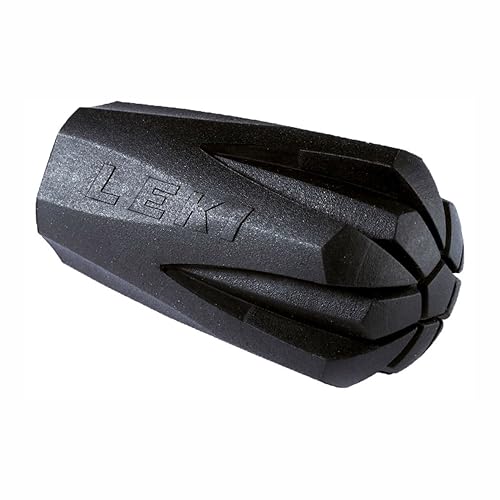
To ensure reliable grip across diverse environments, high-quality walking sticks include slip-on vulcanized rubber ferrules and rounded walking caps. Dense rubber grips securely to dry rock surfaces, asphalt pathways, and tile floors, absorbing ground shock and providing dependable friction. Hikers heading into backcountry mud, loose sand, or deep scree can also attach wide mud baskets just above the ferrule. These screw-on baskets prevent the slender tip from plunging deep into soft earth, ensuring consistent ground support through soggy marshland or winter snowpack.
Packability, Shaft Materials, and Daily Practicality
Choosing between traditional natural timber and modern alloy shafts impacts how and where you can use your walking stick. Solid hardwoods like hickory, oak, sweet chestnut, and hazel offer organic flex, heirloom craftsmanship, and natural vibration dampening, but their fixed lengths make them difficult to transport inside compact vehicles or airplane luggage. In contrast, aircraft-grade 7075 aluminum shafts deliver exceptional fatigue resistance and structural stiffness while collapsing down into remarkably compact packages. Some folding designs break down into three connected sections measuring just 13.4 inches, sliding easily into everyday daypacks.
If you frequently travel by air for hiking vacations, verifying collapsed stick dimensions against carry on luggage pack sizes is an essential packing step. Telescoping poles that disassemble to roughly 21 inches or collapse to 25 inches fit diagonally across standard rolling suitcases, though travelers should always review airline baggage policies regarding walking sticks before flying. Routine ownership care includes wiping away trail dust and grit from locking collars, drying metal shafts after rainy hikes to prevent internal oxidation, and checking rubber ferrules for tread wear so your stick remains dependable for every outing.
Ultimately, the true purpose of a walking stick is to empower you to explore outdoor environments with greater endurance, physical comfort, and balance security. By absorbing joint impact, stabilizing each stride across unpredictable surfaces, and encouraging an upright walking posture, a dependable walking stick serves as an indispensable tool for nature enthusiasts of all ages. Selecting the appropriate shaft length, matching your traction tips to the terrain, and mastering basic slope techniques ensures you enjoy the trail with lasting confidence and steady footing.





Write Your Review
No reviews yet. Be the first to share your experience!