


Steep descents and uneven rocky trails place substantial strain on your leg joints, especially when carrying trail gear across long distances. Dialing in exactly how tall should a hiking stick be transforms a simple wooden branch or modern pole into an essential balance stabilizer that offloads impact from your lower back, hips, and ankles. Holding a staff at the incorrect height can force your shoulders to shrug awkwardly or cause your wrists to bend backward under downward pressure. Matching the stick length to your body geometry ensures that your arms absorb shock naturally without fatiguing your upper body during long day hikes.
Traditional single-staff hikers often favor chest-high lengths for shifting grip positions, while users of modern trekking gear rely on a standard right-angle elbow bend to maintain optimal walking cadence. Pairing proper stick posture with hiking pants designed for knee support helps protect joint cartilage when you navigate steep granite drop-offs and slippery mud. Whether you choose a classic carved hardwood staff, an aircraft-grade aluminum stick, or ultralight carbon fiber, establishing the right length gives you the confidence to steady your footing across uneven terrain. Finding your ideal measurement requires testing your natural posture in your trail footwear before heading outdoors.

Pros
- Durable 7075 aluminum shaft construction resists bending on rocky and uneven trail surfaces
- Moisture-wicking cork handles mold to hand shape for a comfortable grip during warm-weather treks
- Convenient lever locks allow quick, secure height adjustments even while wearing gloves
- Disassembles down to 21 inches for straightforward packing inside carry-ons or external pack attachments
Cons
- At 24.5 inches collapsed and 21 inches disassembled, they pack down longer than folding Z-style trekking poles
- Lever locks require periodic screw tightening to maintain firm clamping pressure over extended trail use
- At 9.7 ounces per pole, aluminum construction is slightly heavier than premium carbon-fiber options
The TrailBuddy Trekking Poles are three-section telescoping hiking sticks engineered for day hikers, backpackers, travelers, and outdoor enthusiasts needing balance assistance. Made with aircraft-grade 7075 aluminum shafts and natural cork grips, these poles serve trail walkers tackling rocky switchbacks, seniors wanting extra stability, and backpackers looking to distribute pack weight off their knees.
Each pole weighs 9.7 ounces, keeping swing weight manageable over high-mileage day hikes and multi-day routes. Height adjusts from a fully collapsed 24.5 inches up to 54 inches, accommodating tall adults down to youth hikers. Quick-release lever locks allow one-handed height changes on trail, making it simple to shorten poles for steep ascents or extend them when descending steep switchbacks.
Aircraft-grade 7075 aluminum provides greater impact resistance and tensile strength than standard aluminum tubing, bending under extreme stress rather than snapping abruptly. Moisture-wicking cork handles mold to the user's palms over time, reducing sweat buildup and friction during humid hikes. Padded wrist straps relieve downward hand strain, while threaded tips prevent mud and snow accessories from twisting off in deep substrate.
Operating these poles requires flipping open the lever locks, sliding the sections to the marked height indicators, and clamping the levers shut. For transport, collapsing the shafts down to 24.5 inches allows them to mount securely onto backpack trekking-pole loops or compression straps. For suitcase packing or compact backpack side pockets, the shafts can be disassembled completely down to 21 inches. Routine maintenance involves wiping off trail grit and inspecting lever tension screws between outings.
While 7075 aluminum offers reliable resilience, each pole weighs 9.7 ounces, which is slightly heavier than ultralight carbon-fiber poles. The telescoping design also has a longer packed profile than compact folding Z-poles, meaning they might protrude higher when lashed to smaller daypacks. Additionally, the manual lever-lock screws must be checked periodically to prevent slippage on steep descents.
For hikers, backpackers, and travelers seeking dependable trail balance at an approachable value, the TrailBuddy 7075 Aluminum Trekking Poles offer a practical mix of rugged construction, ergonomic cork grips, and simple lever adjustments. They are well suited for anyone needing a sturdy, travel-ready walking stick without paying premium carbon-fiber prices.
The TrailBuddy trekking poles feature an adjustable length range spanning from 24.5 inches when fully collapsed up to 54 inches at full extension. This wide vertical adjustment allows users of varied heights, including kids aged seven and up through tall adults, to set proper ninety-degree elbow angles for efficient uphill pushing and downhill braking.
Height adjustments rely on quick-cam lever locks that can be flipped open and closed with one hand. Unlike internal twist mechanisms that can seize up from trail dust or freeze in sub-freezing temperatures, the exterior lever clamps offer visible locking status and easy field tightening via standard adjustment screws.
When preparing for travel or stowing gear at camp, these poles collapse to 24.5 inches, making them compatible with most external backpack gear loops, bungee tie-offs, and side compression straps. For airline luggage or smaller pack interiors, completely separating the three telescoping segments reduces overall length to 21 inches.
This disassembled 21-inch profile allows hikers to slide the shafts into luggage or secure them inside travel-hiking daypacks. The threaded tip design also ensures that baskets and protective rubber covers stay attached during transit rather than falling off inside gear bags.
Crafted from aircraft-grade 7075 aluminum, the shafts provide dependable bending resistance under heavy pack loads and rocky impacts. Aluminum offers a distinct safety benefit over carbon fiber on rugged trails, as it tends to bend rather than splinter under lateral shock.
Ergonomics are handled by genuine cork grips that naturally wick moisture and absorb vibration on hard-packed trails. Over repeated miles, cork contours to individual hand profiles to minimize pressure points, while the padded wrist straps transfer load directly from the forearm to the pole.
Pros
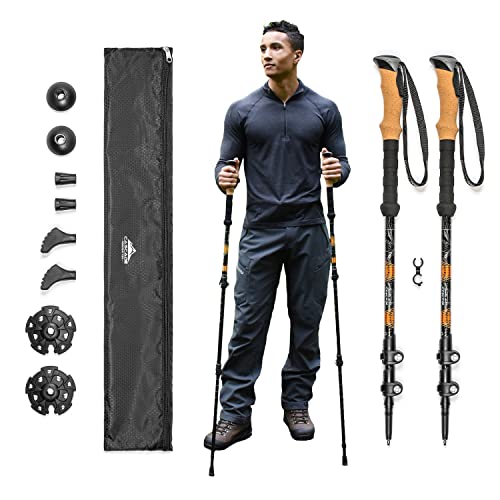
- Sturdy 6061 aluminum shafts resist bending under load across rocky trails and uneven terrain
- Ergonomic cork handles combined with EVA lower grips provide comfortable, versatile hand positions
- Lever-style quick locks allow fast, tool-free length adjustments between 26 and 54 inches
- Generous accessory bundle includes mud baskets, snow baskets, rubber boots, tip covers, and a carry bag
Cons
- Collapsed length of 26 inches may extend above the top collar of smaller 15L to 20L daypacks
- At 10 ounces per pole, aluminum construction is heavier than ultralight carbon fiber designs
- Quick-lock cam tensioners require occasional thumb-screw checks to maintain firm holding pressure over time
The Cascade Mountain Tech 6061 Aluminum Trekking Poles serve as a dependable, budget-conscious trail accessory designed for day hikers, weekend backpackers, and outdoor walkers seeking upper-body engagement and knee relief. Built to pair with standard hiking daypacks and larger backpacking packs, these two-section adjustable poles provide steady points of contact across varied outdoor surfaces.
On the trail, the quick-lock lever mechanism allows smooth height adjustments spanning from 26 inches up to 54 inches to accommodate various hiker heights and changing slope angles. Weighing approximately 10 ounces per pole, the shafts offer solid balance without excessive swing weight. When you reach a flat trail section or scramble where free hands are required, the poles collapse to a manageable 26-inch profile that fits neatly onto external backpack gear loops, side compression straps, or inside the included travel bag.
Material construction centers on aircraft-grade 6061 aluminum, which provides dependable bend resistance when navigating rocky terrain, boulder fields, or stream crossings. The ergonomic handles combine genuine cork tops with extended EVA down grips. The cork sections help dampen ground vibrations and wick moisture away during warm summer hikes, while the lower foam sections let hikers quickly lower their hand positions during steep switchbacks without pausing to readjust pole length.
Dialing in the poles for specific trails is straightforward thanks to the included accessory bundle. The core shafts feature tungsten carbide tips that bite into hard-packed dirt and slick rock surfaces. For paved greenways or sensitive rock paths, push-on rubber boots and tip covers provide traction and prevent surface scarring. When transitioning to wet spring trails or winter routes, the interchangeable mud and snow baskets screw on easily to prevent the poles from sinking deeply into soft ground.
While these poles provide dependable trail stability, prospective buyers should recognize a few practical design tradeoffs. The three-section telescoping design collapses to 26 inches, which is longer than folding Z-style poles and may extend beyond the top of compact 15-liter to 20-liter daypacks. At roughly 10 ounces per pole, aluminum construction also carries a modest weight penalty compared to premium carbon fiber poles. In addition, the quick-lock cam tensioners may require occasional finger-tightening of the thumbscrews to maintain positive locking force over miles of continuous vibration.
For beginner hikers, weekend backpackers, and budget-conscious outdoor enthusiasts looking for reliable trekking poles with comprehensive multi-season accessories, the Cascade Mountain Tech 6061 Aluminum Trekking Poles offer balanced durability and practical trail support.
When not in use, each pole collapses down to a compact 26 inches, allowing hikers to stow them easily along the exterior of most hiking backpacks. Hikers can thread the tungsten carbide tips through standard lower trekking-pole attachment loops and secure the upper shafts using side compression straps or elastic bungi cords.
For travel or vehicle storage, the set includes a lightweight zippered travel bag that prevents dirt, mud, and trail debris on the baskets and tips from contacting the interior fabric of your backpack or luggage. At 10 ounces per pole, carrying them on your pack adds minimal base weight during trail approaches.
The poles arrive with an extensive accessory package configured for year-round hiking versatility. Hard tungsten carbide tips serve as the baseline contact point for dirt singletrack, loose scree, and rugged mountain paths where maximum purchase is necessary.
For asphalt trails, slick boardwalks, or indoor transit, the included rubber boots and tip covers slip over the metal ends to dampen noise and enhance surface grip. The kit also includes wide rubber snow baskets and medium mud baskets, which prevent the poles from sinking into deep drifts, boggy soil, or loose river gravel.

Pros
- Collapses down to a compact 15 inches, fitting easily inside backpacks or carry luggage bags
- Natural cork handles absorb hand perspiration effectively during strenuous hikes
- Sturdy aircraft-grade aluminum construction with protective metal caps at the folding joints
- Simple height adjustment between 110 cm and 130 cm via a sturdy metal flip lock lever
Cons
- TSA regulations require trekking poles to be packed in checked luggage rather than carry-on bags
- Users must verify the push-button lock is fully popped out to ensure shaft stability before hiking
- At 11.5 oz per pole, aluminum construction is heavier than ultralight carbon-fiber alternatives
The Trekology Trek-Z Cork Grip Collapsible Trekking Poles are three-section folding hiking sticks designed for day hikers, backpackers, and adventure travelers who require portable stability on uneven trails. Rather than using traditional telescoping designs that remain long when collapsed, these poles utilize a tri-fold folding cable system that stows down to a compact 15 inches. This makes them a strong match for hikers who prefer storing their poles directly inside a daypack or securing them flat against external pack compression straps without poles protruding past the top lid.
On trail, these poles offer an adjustable length range of 110 cm to 130 cm, covering a stated user height range between 5'2" and 6'5". Each pole weighs 11.5 oz (330 g), delivering a solid feel that helps distribute carried weight and stabilize joint impact on steep descents. The main handle is shaped from natural cork, which naturally absorbs hand moisture and sweat during warm trail outings. Trekology notes that the cork grips incorporate a slight rotational flex as an anti-torque ergonomic feature. Below the cork, secondary EVA foam grips allow hikers to quickly choke down on the poles when negotiating short, steep step-ups without adjusting overall pole length.
Build quality centers on aircraft-grade aluminum alloy shafts, chosen to withstand lateral loads and rocky terrain where brittle materials might crack. To reinforce high-stress connection points, Trekology adds metal caps around the folding joints, reducing play once the poles are deployed. Extension and length adjustments are secured using a durable metal flip lock at the upper section, ensuring reliable clamping power once clamped to the hiker's preferred height marker.
Deploying the poles requires extending the folding sections until the internal tension cable pulls tight and an internal metal lock button pops through the shaft hole. Ensuring this button is fully seated is essential for complete structural rigidity before latching the upper flip lock. For transport, collapsing the poles takes seconds, allowing both poles to slip neatly into the included storage bag. When traveling by commercial air to hiking destinations, keep in mind that TSA and airline policies classify trekking poles as checked luggage, meaning they must be stowed inside checked duffels or backpacks rather than overhead carry-on bags.
While the folding mechanism provides impressive packability, the design does present a few practical limitations. The total adjustment range is 20 cm (110 to 130 cm), which may not suit hikers under 5'2" who require a shorter pole setup. Additionally, at 11.5 oz per pole, weight-conscious thru-hikers aiming for sub-pound base weights might find aluminum folding poles heavier than fixed-length carbon options. The locking button also requires careful initial alignment during assembly to ensure the segments seat properly without wobbling.
For hikers, backpackers, and travelers seeking dependable trail support without spending top-tier outdoor brand prices, the Trekology Trek-Z Cork poles offer exceptional value. The combination of sweat-wicking cork handles, reinforced aluminum joints, and an ultra-packable 15-inch folded size makes them a versatile accessory for everything from local forest walks to rugged mountain backpacking trips.
The Trekology Trek-Z poles adjust between 110 cm and 130 cm in length, accommodating hikers measuring roughly 5'2" to 6'5" (159 to 195 cm) in height. Length adjustments are managed via a metal flip lock clamp on the top shaft section, allowing users to fine-tune height based on trail slope or individual arm ergonomics.
Hikers shorter than 5'2" may find the minimum 110 cm setting too tall for standard 90-degree elbow positioning on level terrain. Always confirm that your forearm rests parallel to the ground when holding the cork grip before clamping the metal flip lock.
Thanks to a three-piece folding design, the Trek-Z poles collapse down to just 15 inches (38 cm) in length. This compact size allows them to fit horizontally or vertically inside most standard daypacks, carry duffels, or luggage cases without hanging loosely off external attachment points.
The poles come with a dedicated carry bag to keep trail mud and dust away from clean gear inside your backpack. Hikers traveling by air should remember that TSA guidelines prohibit trekking poles in carry-on baggage, requiring these poles to travel inside checked luggage.
The pole shafts are manufactured from aircraft-grade aluminum alloy, delivering reliable strength-to-weight performance and high resistance to bending stresses on demanding rocky routes. The connection joints are strengthened with metal caps to guard against joint wear and slippage over time.
The handles feature genuine cork, which helps manage perspiration and adapts comfortably to hand pressure over long miles. A secondary EVA foam grip sits directly beneath the cork for quick hand repositioning on steep gradients without stopping to change shaft length.

Pros
- Folds down to 15 inches, making it significantly easier to pack inside travel luggage or strap to compact daypacks than standard telescoping poles
- Moisture-wicking natural cork handles keep palms dry and comfortable across humid hiking conditions
- Sturdy metal flip locks and reinforced joint caps provide solid structural support without slippage when properly tensioned
- Lower EVA foam grips allow instant trail adjustment for steep uphill climbing
Cons
- At 11.5 ounces per pole, they carry more weight than specialized ultralight carbon fiber poles
- The 110 cm minimum height setting may feel slightly too long for hikers under 5 feet 2 inches
- Per TSA regulations, trekking poles with metal tips must be packed in checked luggage rather than carried on flights
The Trekology Trek-Z Cork Grip Trekking Poles are folding, multi-section hiking sticks designed for hikers, backpackers, and travelers who require sturdy trail stability without the awkward bulk of traditional telescoping poles. Sold as a pair with an included carry bag, these poles suit day hikers tackling uneven paths, weekend backpackers managing load transfer on descents, and outdoor enthusiasts who need compact gear that fits inside travel luggage or standard daypack side sleeves.
Trail packability is one of the standout characteristics of this design. Utilizing a retractable tri-fold cable system, each pole breaks down to just 15 inches (38 cm) in overall length. This short folded dimension lets you slip the pair directly into the main compartment of an overnight pack, tuck them into side stretch-mesh water bottle pockets, or strap them beneath external compression straps without snagging overhead brush. For length adjustment, an upper aluminum section provides a 20 cm sliding range from 110 cm to 130 cm, catering to user heights between 5 feet 2 inches and 6 feet 5 inches.
Component construction focuses on long-term trail durability. Trekology builds the Trek-Z poles from aircraft-grade aluminum alloy, which provides higher impact resistance and flex tolerance against rocky crevices compared to brittle carbon fiber. The folding shaft joints feature protective metal caps to resist wear at stress points during repeated assembly. Up top, the natural cork grip wicks moisture away from sweaty palms during steep ascents, while a secondary EVA foam grip sleeve allows you to lower your hand placement instantly on steep trail grades without adjusting the shaft length.
Deploying and adjusting the poles requires a straightforward two-step setup. After letting the lower segments drop into place, you pull the upper shaft section until an internal metal locking button pops outward with a firm click. A durable metal external flip lock then secures the upper telescoping section at your desired height marker. Proper setup is essential; if the lower shaft feels loose or disconnected, the metal lock button must be firmly pulled until fully seated in its designated catch hole. Maintenance is simple, requiring only an occasional wipe-down with a dry cloth after muddy hikes before packing into the included storage sleeve.
While practical and durable, the Trek-Z design carries a few realistic limitations. Each pole weighs 11.5 ounces (330 grams), resulting in a combined pair weight around 23 ounces, which may deter dedicated ultralight thru-hikers who prefer minimal swing weight. Additionally, the minimum length of 110 cm means youth hikers or adults under 5 feet 2 inches might find the grip positioning too elevated on flat terrain. Travelers should also remember that TSA guidelines require trekking poles with rigid tips to travel inside checked baggage rather than carry-on packs.
For hikers seeking an affordable, compact, and robust set of walking poles, the Trekology Trek-Z Cork Grip poles deliver excellent overall value. They provide dependable joint support, sweat-wicking cork comfort, and pack-friendly folding convenience that fits easily into standard hiking backpacks and travel duffels.
The Trekology Trek-Z poles feature an adjustable working range between 110 cm and 130 cm, making them compatible with users measuring between 5 feet 2 inches and 6 feet 5 inches in height. Sizing adjustments are controlled via a durable metal flip-lock clamp positioned on the upper shaft section, marked with clear centimeter increments for quick alignment.
Hikers can lengthen the poles slightly for steep downhill sections to maintain an upright posture, or shorten them for prolonged uphill climbs. For fast grade transitions where stopping to loosen the clamp is impractical, the extended EVA foam grip below the primary cork handle allows instant choke-down positioning.
Thanks to a three-section folding architecture linked by an internal tension cable, the Trek-Z poles collapse down to an ultra-compact 15 inches (38 cm). This compact footprint allows them to slide vertically inside most 20-liter to 65-liter hiking backpacks, eliminating the tip-heavy snagging hazards common with longer two-piece or three-piece telescoping poles.
A matching carry bag is included to keep trail mud and dust away from sleeping bags, pack liners, and clothing when stored internally. When flying to destination trailheads, note that airline security guidelines require trekking poles to be packed within checked baggage rather than carry-on luggage.
The shafts are manufactured from aircraft-grade aluminum alloy, delivering high tensile strength and resilience against bending forces when supporting heavy backpack loads on rocky trails. The connection joints between segments are reinforced with metal caps to resist cracking and wall deformation under load.
The upper handle utilizes natural cork material that absorbs hand moisture, resisting slick spots during warm summer outings. The handle is engineered with a slight rotational flex that acts as an anti-torque buffer, reducing jarring impacts transmitted through the hands and wrists across prolonged trail miles.
Pros
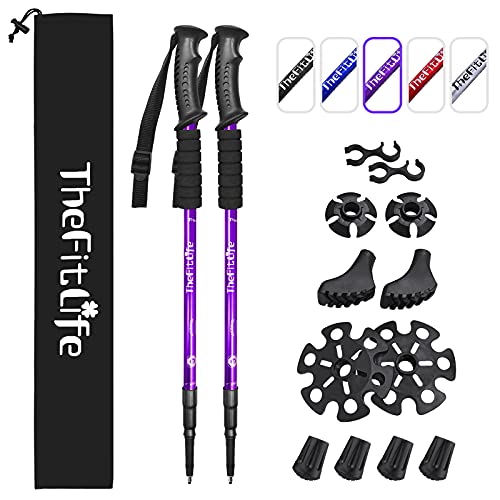
- Lightweight build at only 9.92 oz per pole reduces arm fatigue on long day hikes and backpacking trips
- Internal anti-shock springs help absorb repeated trail impacts on rocky or downhill terrain
- Includes full set of mud baskets, snow baskets, walking caps, and rubber tips for varied trail surfaces
- Disassembles down to 21.46 inches for practical packing inside standard 22-inch travel luggage
Cons
- Internal twist locks require firm manual tightening compared to external flick-lock levers
- Collapsed length of 25.6 inches may protrude above compact daypacks when lashed to external straps
- Rubber grips offer dependable traction but may feel less breathable on hot, sweaty summer hikes than natural cork
TheFitLife Telescopic Trekking Poles are adjustable three-section aluminum hiking sticks designed for day hikers, weekend backpackers, fitness walkers, and travelers who need reliable balance assistance on the trail. Weighing just 9.92 ounces (282 grams) per pole, this set adds minimal weight when strapped to a backpack while offering structural stability for ascending steep inclines and navigating uneven terrain.
Built to accommodate a broad range of user heights, each pole extends from 25.6 inches (65 cm) up to 51.2 inches (130 cm). The internal anti-shock spring system is engineered to dampen trail vibrations each time the pole plants on hard rock or packed dirt. This subtle cushioning effect is particularly helpful during long descents where repetitive shock transfers directly into the wrists, elbows, and knees.
The shafts are constructed from high-strength aluminum alloy, balancing impact resistance with fatigue durability on rocky paths. Rather than using external clamp levers that can catch on underbrush or gear webbing, TheFitLife utilizes a refined internal twist-lock system. It tightens securely with a simple twist, maintaining a streamlined profile that is easy to operate even while wearing trail gloves. Ergonomic non-slip rubber grips provide a firm and comfortable hold throughout changing weather.
Packing and trail transport are straightforward. Outdoor hikers can secure the poles externally using backpack gear loops and compression straps at their collapsed length of 25.6 inches. For travelers packing for distant trailheads, the poles separate completely into three sections measuring 21.46 inches (54.5 cm), allowing them to fit diagonally inside most standard 22-inch or larger travel suitcases. The package also includes mud baskets, snow baskets, protective rubber tips, and walking caps to handle mud, scree, snow, or paved paths.
A realistic consideration is the twist-lock design itself. While it eliminates bulky external hardware, twist mechanisms require deliberate tightening to prevent slipping under heavy vertical pressure, which can be harder to gauge in freezing weather compared to quick-cam levers. Additionally, hikers using small daypacks under 20 liters may find the 25.6-inch collapsed length slightly tall when mounted to smaller exterior pack pockets.
For recreational day hikers, entry-level backpackers, and fitness walkers seeking reliable trail support at a budget-conscious price point, TheFitLife Telescopic Trekking Poles offer strong value. Their combination of joint-cushioning anti-shock springs, solid aluminum durability, and comprehensive seasonal attachments makes them a versatile companion for trails across the country.
TheFitLife Trekking Poles offer a versatile length adjustment range spanning from 25.6 inches (65 cm) to 51.2 inches (130 cm). This broad range allows men, women, teenagers, and seniors to set an optimal pole height that maintains an efficient 90-degree elbow bend on flat terrain.
Height adjustments are controlled by twisting the telescoping sections. Hikers can shorten the shafts during steep uphill climbs to maintain forward momentum or lengthen them on descents to improve balance and stability across rough trail sections.
When hiking with a daypack or backpacking pack, these poles can be secured externally to trekking-pole loops, daisy chains, or side compression straps. Their collapsed profile of 25.6 inches sits comfortably alongside standard 30 to 65-liter backpacks without excessive overhang.
For air travel or off-season storage, the three aluminum sections can be separated entirely. In this disassembled state, the longest section measures 21.46 inches (54.5 cm), making the set compact enough to fit diagonally within most 22-inch or larger luggage bags.
TheFitLife provides a multi-terrain accessory kit with every pair. Included are rubber tips for hard rock surfaces, walking caps designed for paved surfaces and fitness walking, mud baskets to prevent poles from sinking into soft soil, and broader snow baskets for winter trail use.
All included attachments screw on and off quickly in the field without tools. This modular system allows hikers to adapt the poles seamlessly whether navigating muddy spring switchbacks or paved park trails.

Pros
- Lightweight 3K carbon fiber construction reduces carried and swinging weight to 7.6 ounces per pole
- Metal flip locks offer secure, slip-resistant tension compared to traditional twist-lock mechanisms
- Ergonomic cork handles paired with secondary EVA foam grips provide versatile hand positioning on varying trail grades
- Wide 24-inch to 55-inch adjustment span suits a diverse range of user heights and terrain angles
Cons
- Carbon fiber shafts can fracture if wedged between rocks and subjected to severe lateral bending forces
- Collapsed length of 24 inches may extend beyond the top or bottom of ultra-compact daypacks when mounted externally
- Metal flip lock levers require occasional thumb-screw tension checks to prevent slippage over extended mileage
The Hiker Hunger 100% Carbon Fiber Trekking Poles are adjustable three-section telescoping trail poles built for day hikers, section hikers, backpackers, and campers seeking to shed weight without giving up stability. Constructed from 3K carbon fiber, each pole weighs approximately 7.6 ounces, making them an excellent choice for hikers looking to reduce joint impact on rugged trails while keeping their base gear manageable.
In terms of trail adjustment, these poles expand from a compact 24 inches up to a full 55 inches, comfortably serving both shorter and taller hikers across diverse terrain grades. Rather than relying on twist locks that can slip or freeze when exposed to dirt and moisture, Hiker Hunger equips these poles with quick-adjust flip locks built with metal hardware. This provides firm, slip-resistant clamping whether you are lengthening the poles for a steep downhill descent or shortening them for an aggressive ridge climb.
Grip comfort is a primary design focus, featuring ergonomic natural cork handles that actively wick moisture away from your palms while molding to your hand shape over time. Directly beneath the cork handles, secondary nonslip EVA foam extensions provide an immediate choke-down point for short, steep switchbacks, eliminating the need to stop and adjust pole length. Soft neoprene-padded wrist straps further enhance comfort, distributing downward pressure across your wrists without causing chafing during long mileage days.
Transporting and maintaining these poles on the trail is straightforward. When not in use, the shafts collapse down to 24 inches, allowing them to nest securely into side water bottle pockets, slide behind backpack compression straps, or strap onto front trekking-pole attachment loops. Maintenance involves basic trail hygiene: simply wipe away grit and moisture after wet outings and periodically check the thumbscrew tension on the metal flip locks to preserve optimal clamping force.
While carbon fiber provides exceptional weight savings and natural vibration damping, it behaves differently than aluminum under severe lateral stress. If a carbon pole becomes trapped between roots or granite boulders and is subjected to heavy sideways leverage, it is susceptible to cracking or snapping rather than bending. Additionally, hikers using compact daypacks under 20 liters should note that the 24-inch collapsed height will protrude somewhat above the pack rim when lashed to external straps.
For day hikers, multi-day backpackers, and travelers seeking an agile pair of poles with natural cork ergonomics and durable metal locking mechanisms, the Hiker Hunger Carbon Fiber Trekking Poles represent strong trail value. Backed by a 1-year warranty and a USA-based company, they provide dependable knee-saving support and steady balance across varied backcountry trails.
The Hiker Hunger trekking poles feature a telescoping three-section shaft that adjusts smoothly between 24 inches and 55 inches. This expansive range accommodates men, women, and younger hikers across flat paths, steep alpine ascents, and knee-jarring descents.
Length adjustments are secured using external flip locks equipped with metal levers. Unlike plastic components that can warp or weaken over time, the metal locking mechanism maintains consistent clamping pressure against the carbon fiber sections to help prevent unexpected slippage while hiking under load.
Constructed entirely from 100% 3K carbon fiber, these poles offer high tensile strength and natural vibration absorption while weighing only 7.6 ounces per pole. This lightweight profile substantially lowers the energy required per arm swing over long trail days.
The upper handle combines natural moisture-wicking cork with dense EVA foam for the lower grip extension, providing comfortable handholds in both warm and cold weather. To maintain the structural integrity of carbon fiber, hikers should avoid using the poles as pry bars and keep the locking collars clean of trail debris.
With a collapsed length of 24 inches, these poles integrate easily with standard hiking daypacks and multi-day backpacking packs. They can be threaded through dedicated lower trekking-pole loops, secured via upper bungee cords, or held fast by side compression straps.
For travel or public transit to the trailhead, the 24-inch collapsed size allows the pair to fit inside standard checked luggage or across larger duffel bags, keeping your trail gear neatly consolidated between outings.
Comprehensive Height and Sizing Guide for Hiking Sticks and Staffs
A properly sized hiking stick establishes an immediate point of balance that stabilizes your gait across rugged footpaths, slippery roots, and steep switchbacks. Determining how tall should a hiking stick be primarily depends on whether you carry an adjustable single trekking stick or a traditional full-length wooden hiking staff. While modern adjustable walking sticks align with your forearm at a flat right angle, classic one-piece wooden staffs stand taller to accommodate shifting hand positions on variable terrain. Setting the right height prevents shoulder fatigue, keeps your spine aligned, and ensures that downward kinetic force channels safely away from your joints.
The Ninety-Degree Elbow Rule for Standard Walking Sticks
The standard baseline measurement for any recreational walking stick requires your elbow to rest at a crisp ninety-degree bend when you grip the handle. Your forearm should remain completely level with the trail surface while your upper arm rests relaxed along your torso. This right-angle configuration allows your arm muscles to absorb braking forces without forcing your shoulder to shrug upward. If your elbow angle opens wider than ninety degrees, the stick is too short, causing your upper body to slouch forward and placing unwanted strain on your lower back.
Accurate measurement demands that you wear your customary hiking boots or trail shoes while checking your stance on a flat, level surface. Thick lugged outsoles and supportive trail midsoles easily add an inch or more to your standing height compared to barefoot measurements. Resting the stick tip on the floor beside your little toe gives you the true working angle you will experience on outdoor paths. When the stick length matches this baseline, your wrist remains in a neutral position that prevents joint compression during miles of steady walking.
Traditional Hiking Staffs Versus Modern Trekking Poles
Traditional wooden hiking staffs operate under an entirely different sizing philosophy than modern dual trekking poles or standard walking sticks. Classic single staffs carved from resilient hardwoods like hickory, oak, or chestnut typically measure between fifty and fifty-six inches in overall height, reaching somewhere between your armpit and your chin. This extra height provides a versatile lever that accommodates varying trail conditions without requiring mechanical adjustments. Single-staff hikers rely on this extended timber length to lean into steep ascents, probe deep stream beds, and brush back overgrown trail vegetation.
Carrying a tall, one-piece staff leaves your secondary hand completely free to navigate rocky scrambles, grab handrails, or check navigation devices. Rather than adjusting a mechanical shaft, you simply slide your grip up or down along the smooth wood grain as the topography shifts. A taller staff allows you to grasp the upper section when balancing along narrow ridges while keeping the base planted firmly below your center of gravity. For traditional trail walkers, this single balance aid delivers steady security without the technical double-pole cadence required by modern trekking gear.
Adjusting Stick Height for Uphill Climbs and Downhill Descents
Mountain hiking introduces dramatic elevation shifts that disrupt your flat-ground elbow geometry. When climbing steep ascents, the trail rises abruptly in front of your feet, effectively bringing the ground closer to your hands. Shortening an adjustable stick by two to three inches prevents you from overextending your shoulder joint and pushing your elbows higher than your chest. On fixed wooden staffs, moving your hand several inches lower onto an extended grip zone provides the same biomechanical leverage, allowing your upper body to assist your legs during strenuous climbs.
Downhill trekking reverses these mechanical forces and places severe compressive stress across your patellar tendons and knee ligaments. Lengthening an adjustable stick by two to four inches allows you to plant the tip farther down the slope before taking a descending step. This early ground contact decelerates your body weight smoothly, transferring substantial braking shock through the stick shaft instead of your joints. If you hike with a tall wooden staff, cupping the top knob or palm-grip with your hand gives you the reach necessary to brace safely against steep drops.
User Height Correlates with Specific Stick Lengths
Standard height charts offer a reliable starting point when shopping for fixed wooden walking sticks or setting adjustable poles. Hikers measuring under five feet four inches generally require a stick length between thirty-nine and forty-three inches for standard ninety-degree balance walking. Walkers between five feet four inches and five feet eleven inches typically find their natural ninety-degree fit within the range of forty-five to forty-nine inches. Individuals standing six feet tall or taller usually require stick lengths extending from forty-nine to fifty-four inches to maintain proper posture.
Adjustable walking sticks easily bridge these height categories by offering wide mechanical ranges that accommodate multiple family members. For example, the TrailBuddy Trekking Poles and Cascade Mountain Tech Trekking Poles expand up to fifty-four inches while collapsing down to approximately twenty-six inches. Similarly, the 100% Carbon Fiber Trekking Poles by USA Brand feature an adjustment span from twenty-four to fifty-five inches, making them adaptable for short hikers, tall adults, and younger walkers alike. Models like the Telescopic Trekking Poles for Hiking extend to 51.2 inches, providing reliable support across standard height brackets.
Folding models such as the Trekology Trek-Z Cork Grip Collapsible Lightweight poles provide explicit sizing configurations ranging from 110 centimeters to 130 centimeters. This twenty-centimeter adjustment range accommodates hikers from five feet two inches up to six feet five inches in height using secure flip-lock mechanisms. Checking the manufacturer adjustment boundaries ensures that you have enough upper and lower length margin to adapt your stick for varying trail inclinations. Purchasing a stick with sufficient adjustment headroom guarantees that tall walkers do not exceed the safety stop line on telescoping shafts.
Step-by-Step Method to Measure and Cut a Fixed Wooden Staff
Sizing a custom wooden walking stick requires careful measurement before making any permanent saw cuts into seasoned timber. Begin by lacing up your favorite trail footwear and standing upright against a flat wall with your shoulders completely relaxed. Bend your primary walking elbow to a natural ninety-degree angle with your forearm parallel to the floor, forming a loose fist as if gripping a handle. Have a partner measure the vertical distance from the floor up to the top of your closed fist using a rigid metal tape measure.
Always trim excess length strictly from the bottom tip of the wooden shaft rather than altering the carved handle or ergonomic head. Subtract approximately one-half inch from your measured cut line to account for the thickness of the replacement rubber ferrule base. Wrap blue painter tape tightly around the designated cut mark to prevent the outer wood grain from splintering under the teeth of a fine-toothed hand saw. After making a clean, perpendicular cross-cut, bevel the bottom edge slightly with sandpaper so the protective rubber ferrule slides snugly onto the tenon without splitting.
Shaft Materials and Natural Flex Characteristics
The material composition of your walking stick influences how downward force and trail vibrations travel into your arm joints. Solid natural hardwoods like hickory, white oak, sweet chestnut, and hazel provide dense structural rigidity that supports heavy downward pressure on technical trails. The cellular grain structure of seasoned timber provides subtle longitudinal flex, absorbing sharp jolts from rocky ground before the vibration reaches your elbow. Traditional woodworkers prize these native hardwoods because they resist snapping under sudden balance recoveries while developing a handsome patina over years of use.
Modern trail sticks utilize engineered metal alloys and composite fibers to achieve high strength at significantly lower carry weights. Aircraft-grade 6061 and 7075 aluminum alloys, featured in TrailBuddy Trekking Poles and Cascade Mountain Tech Trekking Poles, deliver rugged impact resistance that bends slightly under extreme side loads rather than shearing. Meanwhile, 100% Carbon Fiber Trekking Poles by USA Brand utilize carbon weave shafts weighing just 7.6 ounces each, providing natural vibration dampening that reduces wrist fatigue. Deciding between traditional hardwood heft and ultralight composite tech depends on your preference for classic craftsmanship versus modern pack weight.
Handle Ergonomics and Grip Sizing Impact
Handle architecture plays an essential role in where your hand sits relative to the total height of the stick. Traditional crook and derby handles position your palm directly over the vertical center of the shaft, maximizing downward stability for everyday neighborhood walks. Rounded knob handles and carved ball heads on tall hiking staffs allow you to palm the top during steep descents, effectively adding two inches of usable reach. Contoured orthopedic palm-grips distribute weight across your entire palm, preventing localized pressure points that can trigger joint discomfort for walkers with hand arthritis.
Grip materials further determine how securely your hand connects with the stick in damp or humid weather. Natural cork grips, such as those found on Trekology Trek-Z Cork Grip Collapsible Lightweight poles, mold to your hand contours over time while actively wicking perspiration. Many modern models incorporate extended EVA foam down-grips below the primary handle, allowing you to choke down on steep inclines without stopping to adjust mechanical locks. Padded, adjustable wrist straps loop gently around the base of your thumb, helping transfer downward force through your forearms without demanding a tight grip on the handle.
Traction Tips and Ferrule Considerations
Selecting the proper ground contact tip ensures that your stick maintains traction without skittering across slick surfaces. Vulcanized rubber ferrules are mandatory equipment when walking across hard surfaces like paved sidewalks, asphalt greenways, and slick indoor tile. These thick rubber caps dampen noisy impacts, grip polished surfaces securely, and protect finished flooring from gouges. High-quality rubber ferrules incorporate an internal metal washer at the base of the socket, preventing the sharp wooden tenon or metal tip from puncturing through the rubber pad.
Outdoor woodland trails and rocky mountain routes demand harder tips that bite into loose organic soil and frozen gravel. Tungsten carbide spikes penetrate slick mud, decomposed granite, and patch ice to deliver uncompromising single-point purchase. When snow or boggy mud softens the trail tread, threading wide mud or snow baskets onto the lower ferrule prevents the stick from sinking deeply into the muck. Keep in mind that installing a thick rubber pavement foot over a carbide spike increases the total stick height by nearly half an inch, slightly altering your resting elbow angle.
Packability and Transit Sizing for Travel Sticks
Transporting a walking stick presents practical challenges that vary widely between rigid wooden staffs and modern collapsible models. Traditional one-piece wooden staffs cannot fit into standard vehicle trunks or airline overhead bins, requiring dedicated vehicle racks or external gear straps. Telescoping sticks address this travel hurdle by sliding into three compact nested sections using external lever locks or internal twist mechanisms. For example, Telescopic Trekking Poles for Hiking collapse down to 25.6 inches and disassemble completely to 21.46 inches to fit diagonally inside standard travel luggage.
Tri-fold folding poles offer the most compact packing profile for outdoor travelers navigating strict transit luggage limits. The Trekology Trek-Z Cork Grip Collapsible Lightweight poles fold down to a compact fifteen inches using an internal tension cable system. Checking your gear against a comprehensive carry-on backpack capacity guide helps ensure that your collapsed poles and trail accessories fit neatly inside your luggage before airport transit. Always verify that mechanical flip levers and lock buttons seat firmly into place after reassembling your travel poles before tackling steep terrain.
Recognizing Safety Boundaries Between Balance Aids and Clinical Canes
Recreational walking sticks and traditional hiking staffs serve primarily as balance aids and kinetic stabilizers for outdoor activity. These recreational tools are engineered to offload joint pressure, steady your gait across uneven terrain, and assist with general trail stability. They are not certified medical mobility devices, prescription quad canes, or clinical crutches intended for complete weight-bearing rehabilitation. If you are recovering from acute lower-limb surgery, severe musculoskeletal injuries, or vestibular balance disorders, consult a qualified healthcare provider for certified orthopedic mobility equipment.
Regular safety inspections ensure that your balance stick remains dependable and safe throughout rigorous outdoor excursions. Before every hike, inspect wooden shafts thoroughly for deep longitudinal checks, hairline cracks, or fungal decay caused by trapped moisture. On adjustable aluminum and carbon fiber poles, test each mechanical cam-lever clamp by bearing firm downward body weight onto the handles while standing on a level floor. Never venture onto steep technical trails if an adjustment lock slips or if a rubber ferrule shows internal metal exposure from severe abrasive wear.
Finding the exact height for your hiking stick transforms every trail outing into a smoother, more balanced outdoor journey. Whether you establish a ninety-degree elbow angle on an adjustable aluminum pole or rely on a traditional chest-high hardwood staff, proper sizing protects your joints and preserves your endurance. Take the time to measure your stance while wearing your trail footwear, test your grip on local inclines, and verify your tip hardware before your next trek.




Write Your Review
No reviews yet. Be the first to share your experience!