


Navigating uneven terrain, steep descents, or loose gravel places substantial stress on the lower body. Many outdoor enthusiasts wonder what are walking sticks for when planning their day hikes or neighborhood walks. These classic balance aids serve as an extended point of contact with the ground, redistributing body weight away from tired lower limbs while stabilizing each step across slick roots, mud, and rocks.
Beyond simple stability, using a hiking staff helps walkers maintain an upright posture that opens the chest for easier breathing on long ascents. When paired with supportive knee hiking pants, a sturdy staff significantly softens repetitive impact on joints during steep downhill sections. Modern multi-section aluminum poles and traditional wooden walking sticks both deliver dependable trail confidence without feeling like clinical mobility aids.
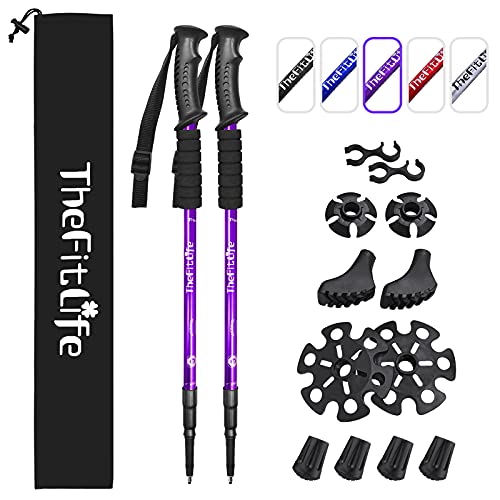
Pros
- Lightweight build at only 9.92 oz per pole reduces arm fatigue on long day hikes and backpacking trips
- Internal anti-shock springs help absorb repeated trail impacts on rocky or downhill terrain
- Includes full set of mud baskets, snow baskets, walking caps, and rubber tips for varied trail surfaces
- Disassembles down to 21.46 inches for practical packing inside standard 22-inch travel luggage
Cons
- Internal twist locks require firm manual tightening compared to external flick-lock levers
- Collapsed length of 25.6 inches may protrude above compact daypacks when lashed to external straps
- Rubber grips offer dependable traction but may feel less breathable on hot, sweaty summer hikes than natural cork
TheFitLife Telescopic Trekking Poles are adjustable three-section aluminum hiking sticks designed for day hikers, weekend backpackers, fitness walkers, and travelers who need reliable balance assistance on the trail. Weighing just 9.92 ounces (282 grams) per pole, this set adds minimal weight when strapped to a backpack while offering structural stability for ascending steep inclines and navigating uneven terrain.
Built to accommodate a broad range of user heights, each pole extends from 25.6 inches (65 cm) up to 51.2 inches (130 cm). The internal anti-shock spring system is engineered to dampen trail vibrations each time the pole plants on hard rock or packed dirt. This subtle cushioning effect is particularly helpful during long descents where repetitive shock transfers directly into the wrists, elbows, and knees.
The shafts are constructed from high-strength aluminum alloy, balancing impact resistance with fatigue durability on rocky paths. Rather than using external clamp levers that can catch on underbrush or gear webbing, TheFitLife utilizes a refined internal twist-lock system. It tightens securely with a simple twist, maintaining a streamlined profile that is easy to operate even while wearing trail gloves. Ergonomic non-slip rubber grips provide a firm and comfortable hold throughout changing weather.
Packing and trail transport are straightforward. Outdoor hikers can secure the poles externally using backpack gear loops and compression straps at their collapsed length of 25.6 inches. For travelers packing for distant trailheads, the poles separate completely into three sections measuring 21.46 inches (54.5 cm), allowing them to fit diagonally inside most standard 22-inch or larger travel suitcases. The package also includes mud baskets, snow baskets, protective rubber tips, and walking caps to handle mud, scree, snow, or paved paths.
A realistic consideration is the twist-lock design itself. While it eliminates bulky external hardware, twist mechanisms require deliberate tightening to prevent slipping under heavy vertical pressure, which can be harder to gauge in freezing weather compared to quick-cam levers. Additionally, hikers using small daypacks under 20 liters may find the 25.6-inch collapsed length slightly tall when mounted to smaller exterior pack pockets.
For recreational day hikers, entry-level backpackers, and fitness walkers seeking reliable trail support at a budget-conscious price point, TheFitLife Telescopic Trekking Poles offer strong value. Their combination of joint-cushioning anti-shock springs, solid aluminum durability, and comprehensive seasonal attachments makes them a versatile companion for trails across the country.
TheFitLife Trekking Poles offer a versatile length adjustment range spanning from 25.6 inches (65 cm) to 51.2 inches (130 cm). This broad range allows men, women, teenagers, and seniors to set an optimal pole height that maintains an efficient 90-degree elbow bend on flat terrain.
Height adjustments are controlled by twisting the telescoping sections. Hikers can shorten the shafts during steep uphill climbs to maintain forward momentum or lengthen them on descents to improve balance and stability across rough trail sections.
When hiking with a daypack or backpacking pack, these poles can be secured externally to trekking-pole loops, daisy chains, or side compression straps. Their collapsed profile of 25.6 inches sits comfortably alongside standard 30 to 65-liter backpacks without excessive overhang.
For air travel or off-season storage, the three aluminum sections can be separated entirely. In this disassembled state, the longest section measures 21.46 inches (54.5 cm), making the set compact enough to fit diagonally within most 22-inch or larger luggage bags.
TheFitLife provides a multi-terrain accessory kit with every pair. Included are rubber tips for hard rock surfaces, walking caps designed for paved surfaces and fitness walking, mud baskets to prevent poles from sinking into soft soil, and broader snow baskets for winter trail use.
All included attachments screw on and off quickly in the field without tools. This modular system allows hikers to adapt the poles seamlessly whether navigating muddy spring switchbacks or paved park trails.

Pros
- Lightweight 9.92 oz aluminum build delivers sturdy trail balance without unnecessary swing weight
- Three-section breakdown fits diagonally in 22-inch suitcases or straps cleanly to hiking daypack loops
- Internal anti-shock spring cushions downward pressure during steep, sustained mountain descents
- Comes complete with four versatile tip and basket attachments suited for year-round trail conditions
Cons
- Twist-lock mechanisms require firm manual tightening and lack the visual verification of external lever flick-locks
- Rubber grips do not wick perspiration as naturally as cork handles during hot summer hikes
- Full 25.6-inch collapsed length may extend beyond the top of compact daypacks unless disassembled
TheFitLife Telescopic Trekking Poles are three-section aluminum hiking sticks designed for day hikers, weekend backpackers, and travel-oriented walkers seeking joint support and trail balance. Featuring an integrated anti-shock spring and an internal twist-lock system, this pole pair caters to budget-conscious outdoor enthusiasts, beginners, and fitness walkers. Because they collapse and disassemble into three compact segments, they serve hikers who regularly transport their gear via 22-inch travel luggage or external backpack attachment loops.
On the trail, weight management and proper height adjustment remain critical for maintaining a steady rhythm. Each pole weighs 9.92 ounces (282 grams), resulting in an aggregate weight of just over 1.5 pounds for the pair. The telescopic aluminum shafts adjust across a usable range of 25.6 inches (65 cm) up to 51.2 inches (130 cm), accommodating men, women, teens, and seniors. When navigating steep descents, the internal anti-shock mechanism activates under downward pressure to absorb trail vibration, while the ergonomic rubber grips deliver steady hand placement across varied walking paces.
The shafts are fabricated from high-strength aluminum alloy, engineered to offer dependable impact resistance against roots, scree, and rocky paths without premature fatigue. TheFitLife utilizes an internal twist-lock mechanism rather than external cam levers, creating a streamlined, low-profile outer diameter that will not catch on dense brush or snag against backpack compression webbing. While the rubber grips lack the moisture-wicking properties of natural cork, their textured surface provides a non-slip grasp in damp conditions, paired with an adjustable wrist strap to help secure your grip.
Transporting these poles alongside your hiking pack or travel baggage is straightforward. When fully collapsed, the poles measure 25.6 inches, making them ideal for securing directly against backpack trekking-pole loops and upper compression straps. For air travel or compact gear totes, each pole disassembles into three independent sections measuring 21.46 inches (54.5 cm), allowing them to slip diagonally into most 22-inch or larger suitcases. Swapping the included rubber tips, flat walking caps, mud baskets, and snow baskets is tool-free, enabling quick configuration changes before heading onto muddy switchbacks or hard pavement.
While practical and versatile, this design presents a few real-world limitations. The internal twist locks require careful hand tightening to avoid accidental slippage under heavy body loads, and they lack the visual security checks provided by external lever locks. In addition, the 25.6-inch collapsed length can extend noticeably above smaller hydration packs or 15-liter daypacks if you do not disassemble them completely. Hikers who prefer ultralight carbon fiber construction or naturally cooling cork handles will also notice the denser feel and moisture retention of the rubber grip material on warm afternoon treks.
For hikers, campers, and travelers searching for an affordable, full-featured trekking pole set that integrates smoothly with backpack lash loops and standard luggage, TheFitLife Telescopic Trekking Poles offer balanced utility. Their aluminum strength, internal anti-shock cushioning, and comprehensive basket kit make them a practical gear choice for everyday trail walks and weekend mountain outings alike.
When preparing for trail outings or flights, gear packability is essential. TheFitLife Telescopic Trekking Poles adjust from a minimum collapsed height of 25.6 inches (65 cm) to a maximum deployed length of 51.2 inches (130 cm). For routine day hiking, the collapsed poles slide easily through lower trekking-pole gear loops on standard daypacks and secure firmly under side compression straps.
For travelers flying to trail destinations, the three aluminum segments can be pulled apart completely. Disassembled, the longest pole section measures 21.46 inches (54.5 cm), allowing the set to lay diagonally inside standard 22-inch or larger hard-shell and soft-sided suitcases. Hikers should verify their pack dimensions and luggage interior measurements before departure to ensure compliant packing.
TheFitLife provides a multi-season accessory kit that expands the poles' versatility across various terrain types. The package includes standard rubber tips for road walking and pavement, wide walking caps for improved asphalt traction, mud baskets to prevent pole sinkage on soft soil, and wide snow baskets for winter trail excursions.
All accessories thread and press securely onto the pole ends without specialized tools. Hikers should inspect the wear on rubber tips and check basket tightness prior to hitting rocky backcountry routes, storing unused attachments in an organizer pouch inside their backpack until needed.
The Functional Purpose and Biomechanics of Walking Sticks
Core Purposes: Stability, Joint Offloading, and Trail Cadence
At its most fundamental level, a walking stick converts human bipedal motion into a stable three-point contact system. Placing a solid staff on the ground creates an expanded base of support that immediately lowers the risk of slips on unpredictable surfaces. Hikers frequently encounter slick moss, wet clay, and loose scree where single-foot slips can easily trigger an uncontrolled fall. With a third point planted firmly ahead or to the side, balance recovery happens almost instinctively before a slip turns into an injury.
Joint offloading represents another primary reason walkers rely on a dedicated stick. Every downhill step forces the quadriceps, patellar tendons, and lower back to absorb intense deceleration loads. By transferring a fraction of each impact through the hand, arm, and shoulder girdle into the shaft, the stick reduces cumulative stress across the lower kinetic chain. This biomechanical sharing allows recreational walkers to hike longer distances with noticeably less leg exhaustion.
A walking stick also establishes a predictable walking rhythm across long, flat stretches and gradual climbs. Swinging the stick in cadence with opposite foot strikes encourages a steady, energy-efficient pace. This rhythmic movement keeps arm muscles engaged and promotes active circulation through the upper extremities. Walkers who establish this steady tempo often report feeling less sluggish during extended backcountry outings.
Downhill Braking Physics and Uphill Propulsion
Downhill hiking presents unique physical challenges because gravity accelerates the body forward with each descending footfall. When descending steep switchbacks, a hiker plants the walking stick slightly ahead of the lead foot to act as a mechanical braking lever. The downward force applied to the handle engages the triceps, latissimus dorsi, and core muscles to control deceleration. This technique prevents the knees from taking the blunt force of jarring drops over rock ledges and exposed roots.
Ascending steep inclines reverses these physical demands by requiring continuous upward thrust against gravity. When moving uphill, a hiker plants the staff closer to the body and leans slightly forward into the stride. Pressing down on the stick engages the pectorals and shoulders, providing a noticeable upward push that assists the calves and glutes. This upper-body propulsion helps maintain momentum on grueling mountain passes without exhausting the leg muscles prematurely.
Proper body alignment plays a vital role during both climbs and descents. Hikers who lean excessively sideways into their staff risk straining shoulder joints or losing traction on loose surfaces. Keeping the stick close to the body centerline ensures that downward force travels straight down the shaft. Wearing lightweight hiking pants allows full freedom of movement at the hips, making it easier to maintain this balanced posture through tricky elevation changes.
Walking Sticks Versus Trekking Poles and Canes
Understanding the difference between walking sticks, dual trekking poles, and medical canes helps outdoor enthusiasts choose the right gear for their specific activities. A single walking stick or traditional hiking staff keeps one hand entirely free throughout the trek. That free hand remains available for checking GPS devices, holding hydration bottles, parting brush, or scrambling over boulders. In contrast, dual trekking poles occupy both hands in a synchronized cadence popular in cross-country trail fitness.
Medical canes serve a fundamentally different purpose than outdoor walking sticks. Prescription canes feature specific shaft angles and offset handles engineered to bear full clinical body weight on flat indoor flooring or sidewalks. Walking sticks, whether crafted from seasoned wood or aircraft-grade aluminum alloy, function as recreational balance aids rather than clinical rehabilitation devices. They provide active outdoor support without carrying the institutional look of medical hardware.
Recreational walkers often appreciate the timeless aesthetic of a classic wooden hiking staff. Traditional sticks evoke a sense of outdoor heritage and craftsmanship that clinical mobility aids completely lack. Active adults who want subtle stability support on neighborhood walks find that a handsome wooden or sleek telescoping stick offers dignity and outdoor confidence. This balance of function and styling makes the walking stick an enduring favorite across generations.
Handle Ergonomics and Dynamic Grip Positioning
The handle shape of a walking stick directly dictates how comfortably force transfers from the palm into the shaft. Classic derby handles feature a gentle horizontal contour that aligns naturally with the palm, distributing downward pressure evenly across the hand. Tourist crook handles offer a traditional curved shape that allows hikers to hook the stick easily over their forearm when reaching for gear. Both handle profiles excel on neighborhood paths and gentle woodland trails where hand position remains fairly constant.
Tall hiking staffs and modern multi-grip poles often feature rounded knob tops or extended grip sleeves. Palming a smooth knob from above gives hikers exceptional control and downward leverage while stepping down steep terrain drops. Extended grip zones made of textured rubber or dense foam allow hikers to choke down their hand position on steep ascents without stopping to adjust stick length. This grip versatility provides immediate adaptation to undulating trail topography.
Wrist lanyards and straps provide secondary support by allowing hikers to rest their wrists against the strap tension during downward thrusts. However, trail conditions dictate when to use or loosen wrist straps. On steep, rocky descents where a sudden fall is possible, hikers should consider slipping their hands out of tight straps. Freeing the hands ensures that if the stick tip becomes wedged in a boulder crack, the hiker will not suffer a wrenched wrist or trapped arm during a fall.
Height Sizing Protocols: The 90-Degree Rule Versus Staff Sizing
Selecting the correct stick height is essential for preventing upper-body strain and maintaining proper spinal alignment. For standard walking sticks used on flat or gently rolling terrain, the universal guideline is the 90-degree elbow rule. While standing upright in your normal walking shoes, hold the stick handle so your elbow forms a clean right angle. Your forearm should rest parallel to the ground, keeping your shoulders relaxed and level.
Traditional full-length hiking staffs follow a completely different sizing standard than standard balance sticks. These staffs typically measure between 50 and 55 inches in length, reaching roughly between the user shoulder and chin. A taller staff allows the user to shift their grip along the shaft dynamically as the trail pitch changes. Hikers hold the staff high on steep descents for forward reach, and grip it lower on climbs without altering the stick overall structure.
Using a stick that is improperly sized leads to distinct physical complaints over several miles. A stick that is too short forces the walker into a forward slouch that compresses the spine and strains lower back muscles. Conversely, a stick that is too tall forces the shoulder upward toward the ear with every plant, leading to trapezius stiffness and neck fatigue. Taking time to establish proper height ensures balanced posture and efficient energy transfer.
Traction Hardware: Ferrules, Spikes, and Trail Baskets
The ground contact point of a walking stick determines its traction and safety across different outdoor surfaces. Vulcanized rubber ferrules are the standard choice for paved sidewalks, asphalt greenways, slick granite slabs, and indoor flooring. Bare metal tips slide dangerously across hard, non-porous surfaces like polished stone and asphalt. Dense rubber feet flex under downward pressure, providing reliable surface grip while dampening the harsh vibration of hard impacts.
Quality replacement rubber tips include an integrated steel washer embedded inside the bottom socket. This internal metal washer prevents the hardened tip of the shaft or tenon from puncturing through the rubber base under heavy downward loads. Hikers should periodically inspect the underside of rubber ferrules for signs of wear. Once the tread pattern wears smooth or the internal washer becomes visible, replacing the ferrule immediately restores secure traction.
Natural trail paths require aggressive bite that rubber feet cannot provide on loose soil. Removing the rubber cap exposes a durable carbide or hardened steel spike designed to pierce through forest loam, decomposed granite, and trail ice. In soft terrain, attaching threaded mud baskets prevents the pole from plunging deeply into muddy bogs or loose scree. Snow baskets provide an even wider surface area to keep poles stable during winter excursions.
Shaft Materials and Shock Dampening Dynamics
Shaft material dictates how a walking stick handles structural load, swing balance, and trail vibrations. Traditional hardwoods such as hickory, white oak, sweet chestnut, and hazel have remained outdoor favorites for centuries. Dense hardwood grain possesses natural organic flex that absorbs trail shock without flexing excessively under body weight. Handcrafted wooden sticks offer distinct character, warm tactile comfort in cold weather, and exceptional longevity when properly maintained.
Modern walking sticks frequently utilize aircraft-grade aluminum alloys, such as those found in TheFitLife telescopic trekking poles. Aluminum poles deliver an impressive strength-to-weight ratio, weighing roughly ten ounces per pole while maintaining dependable impact resistance. Aluminum flexes slightly under lateral stress without snapping, making it an exceptionally forgiving material for rugged mountain trails. Furthermore, aluminum shafts do not absorb moisture, eliminating risks of rotting or warping in damp conditions.
Mechanical shock dampening is another feature built into advanced telescoping models. Internal anti-shock springs located within the shaft sections absorb sudden impact spikes when the tip strikes buried rocks or hard ground. This dampening mechanism softens the repetitive shock waves that would otherwise travel directly into the wrist, elbow, and shoulder joints. Walkers managing joint sensitivity or mild arthritis often find that spring-assisted dampening noticeably reduces post-hike arm soreness.
Trail Utility Beyond Balance and Joint Support
Experienced hikers rely on walking sticks for numerous functional trail tasks that extend well beyond personal balance. A sturdy staff serves as an invaluable depth probe when crossing murky mountain streams or navigating flooded marshland. Tapping the stream bed ahead reveals submerged rocks, slippery algae, and sudden drop-offs before committing your full body weight to a step. This probing capability prevents unexpected water submersions and painful ankle twists in river crossings.
Dense trail overgrowth presents another common scenario where a walking stick proves its worth. Morning hikers frequently encounter heavy spiderwebs strung across narrow forest trails. Sweeping a walking stick ahead clears webs, stinging nettles, and thorny brambles without scratching hands or faces. A staff also allows hikers to push back dense foliage safely when inspecting trail markers or negotiating overgrown game paths.
In backcountry environments, a solid staff provides peace of mind as a non-threatening deterrent against aggressive wildlife. Holding a tall staff upright increases a hiker perceived visual height to curious animals like coyotes or off-leash dogs. A stick can also serve as an emergency splint in wilderness first aid situations or as a central support pole for pitching an ultralight emergency tarp shelter.
Packability, Travel Logistics, and Transport Sizing
Transporting a walking stick requires balancing rigidity with packable convenience. Rigid one-piece wooden staffs offer unbroken structural strength and heirloom aesthetics, but they do not fit inside vehicle trunks or standard luggage easily. Multi-section telescoping sticks solve this travel challenge by collapsing into compact lengths. For example, three-section aluminum models collapse down to approximately 26 inches and can be disassembled into sections measuring under 22 inches.
When preparing for flight travel, packing regulations require careful planning. Transportation security guidelines generally prohibit carrying sharp metal-tipped hiking sticks in carry-on bags. Disassembling multi-piece poles allows them to fit diagonally inside standard 22-inch checked suitcases without damaging luggage seams. Reviewing our carry-on backpack sizing guide helps travelers plan gear placement effectively when flying to distant trail destinations.
Day hikers navigating mixed terrain appreciate external backpack lash points. When traversing paved road sections or gentle flat paths where sticks are unnecessary, securing collapsed poles to pack loops keeps hands free without adding clumsy bulk. Streamlined twist-lock mechanisms prevent exterior snags when moving through thick brush, ensuring poles remain securely stowed until rugged trails demand their support.
Care, Maintenance, and Safe Balance Boundaries
Routine maintenance preserves the structural reliability of walking sticks across many seasons of regular use. Handcrafted wooden staffs benefit from an annual application of boiled linseed oil or pure tung oil to preserve grain moisture and prevent surface checking. After wet hikes in mud or snow, wipe wooden sticks dry with a clean cloth and store them away from direct heat sources to prevent warping. Inspecting the timber periodically ensures hairline splits are caught before they compromise structural strength.
Adjustable aluminum poles require straightforward mechanical cleaning to keep locking mechanisms functioning smoothly. After hiking in sandy or muddy conditions, pull the telescoping sections apart completely to wipe away grit and trail dust. Allowing moisture to dry before reassembling prevents internal oxidation and ensures twist-lock expanding collars grip the inner tube walls securely. Never lubricate telescoping shafts with oil or grease, as lubricants will cause locking collars to slip under downward weight.
While walking sticks provide exceptional stability, understanding their structural boundaries ensures safe outdoor recreation. Recreational sticks and hiking staffs are designed as balance-assist aids rather than medical crutches for non-weight-bearing injuries. Hikers should never lean their entire body weight over cliff edges or rely on a stick as a technical climbing anchor. Using a walking stick thoughtfully within its design limits ensures dependable support, upright posture, and trail enjoyment on every journey.





Write Your Review
No reviews yet. Be the first to share your experience!