


Navigating uneven dirt trails and neighborhood paths requires dependable balance, yet an improperly sized balance aid quickly leads to shoulder strain and awkward posture. Many recreational walkers struggle to establish %what is the correct length for a walking stick% before heading outdoors. Choosing the right measurement keeps your forearm level, takes unwanted stress off your joints, and ensures your stride remains fluid on varied terrain. When paired with supportive knee hiking pants, a properly measured stick significantly stabilizes your descent across slick rocks and steep slopes.
Whether you prefer a handcrafted wooden hiking staff or an adjustable carbon fiber pole, height determines how effectively the shaft absorbs impact. A stick that sits too tall forces your elbow upward into an unnatural angle, while a short staff causes you to hunch forward and compromise spinal alignment. Finding the ideal measurement is not complicated, but it does require understanding the difference between standard walking sticks and taller mountain staffs. With accurate sizing, you gain confidence on gravel, mud, and hard pavement while avoiding unnecessary fatigue.

Pros
- Lightweight carbon fiber shaft keeps total carried weight low on long hikes
- Comfortable cork handles wick moisture effectively during warm-weather ascents
- Fast and reliable quick-lock clamps make height adjustments simple on the move
- Generous accessory package covers varied surfaces from pavement to deep snow
- Includes a travel carry bag and pole clip for organized transport and pack storage
Cons
- Minimum collapsed length of 26 inches extends beyond the frame of compact daypacks
- Carbon fiber shafts can fracture if subjected to severe lateral leverage or rock jams
- Quick-lock tension screws require occasional manual tightening to avoid slippage
The Cascade Mountain Tech Carbon Fiber Trekking Poles are three-section telescoping trail sticks engineered for day hikers, weekend backpackers, and thru-hikers who want to minimize pack weight without paying premium prices. Weighing roughly 8.1 oz per pole, these carbon fiber hiking sticks serve as high-utility trail equipment that easily complements daypacks, overnight packs, and ultralight gear setups. For hikers traversing uneven switchbacks, descending loose scree, or fording streams, these poles provide essential stability, help maintain rhythm, and distribute physical effort across the upper body.
Adjustability is handled through a pair of external quick-lock lever clamps on each shaft, allowing the poles to extend from a 26-inch collapsed length up to a maximum height of 54 inches. This broad adjustment range accommodates a wide variety of hiker heights and allows fast on-trail modifications when alternating between steep uphill climbs and controlled downhill descents. The quick-lock design enables swift height changes in cold or wet conditions without requiring the frustrating twisting motions typical of internal expander mechanisms. When stowed, the 26-inch collapsed size slides easily into backpack side pockets and secures under side compression straps.
Shaft construction centers on lightweight carbon fiber tubing, which provides natural vibration dampening that helps lessen shock on wrists, elbows, and shoulders over long miles. The main handles are built with contoured natural cork that wicks sweat and molds comfortably to your grip over time. Below the cork handle, an extended lower grip offers a soft secondary surface for your hands, allowing you to choke down momentarily on steep ascents without stopping to shorten the shafts. At the base, hard tungsten carbide tips offer reliable bite on hard-packed soil and slick rock, while the adjustable wrist straps keep the grips secure in hand.
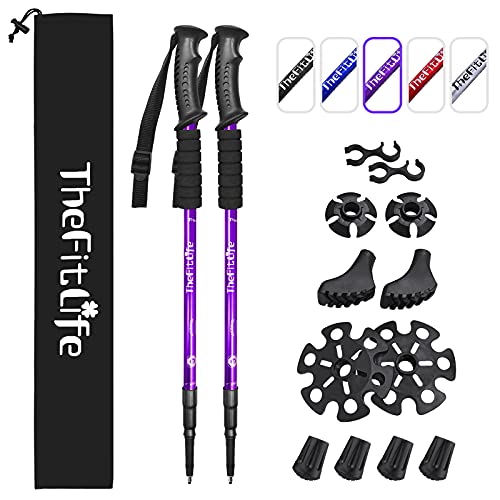
A notable advantage of this Cascade Mountain Tech set is the complete accessory package supplied in the box. Hikers receive protective rubber tips and rock boot tips for hard surfaces or asphalt road walking, wide mud and sand baskets for soft backcountry trails, and larger snow baskets for winter snowshoeing or shoulder-season drifts. A storage clip holds the poles together during transport, and the included drawstring carry bag protects your vehicle interior and hiking pack fabric from sharp tip abrasion when travelling to and from the trailhead.
While carbon fiber provides an excellent stiffness-to-weight balance, it has practical material tradeoffs compared to heavier aluminum poles. Carbon fiber tubing can crack or snap catastrophically if caught in a deep rock crevice and subjected to extreme sideways bending leverage. Additionally, the 26-inch minimum length is longer than folding Z-pole designs, meaning the poles will stick out above smaller 15-to-20-liter daypacks when strapped to exterior loops. Hikers should also verify and adjust the thumbscrew tension on the quick locks prior to major trips to ensure the clamps stay firmly locked under full body weight.
For beginner hikers, section backpackers, and budget-conscious trail enthusiasts, the Cascade Mountain Tech Carbon Fiber Trekking Poles deliver dependable build quality and exceptional real-world utility. They combine the premium touch of moisture-wicking cork handles with rapid length adjustment and an accessory bundle that many brands sell separately. If you need a reliable, lightweight set of hiking sticks that mounts easily to your backpack and handles multiple seasons of trail use, this package represents one of the strongest values available.
These Cascade Mountain Tech poles feature an adjustable length range spanning from 26 inches up to 54 inches, making them adaptable to most adult hikers as well as growing teenagers. Clear increment markings printed along the upper and lower shaft sections make it easy to align both poles to matching heights after deploying them from your backpack.
The external quick-lock levers can be opened and closed easily, even while wearing trail gloves. If the shafts slide under heavy downward pressure, the integrated tension thumbscrew can be tightened by hand to restore firm clamping force. The padded, adjustable wrist straps can be lengthened or shortened quickly to provide balanced wrist support and prevent hand fatigue during long downhill sections.
At a collapsed length of 26 inches, these poles are designed to attach externally to most medium and large hiking backpacks using standard trekking pole loops, bungee keepers, or lower side compression straps. Placing the pole tips into a side water bottle pocket and securing the shafts with upper compression straps keeps them stabilized against your pack body during bushwhacks or scrambles.
For travel and off-season storage, the included carry bag encloses the complete set to prevent carbide tips from puncturing gear, car upholstery, or luggage liners. The set also comes with a plastic dual-pole clip that snaps the shafts together, preventing loose rattling inside a gear bin or trunk between weekend trail outings.
The package comes equipped with an extensive assortment of interchangeable trail tips and baskets, allowing the poles to adapt to diverse terrain and seasonal weather. The pre-installed tungsten carbide tips provide direct purchase on trail dirt, roots, and bedrock for backcountry hiking.
For paved surfaces, neighborhood walking, or slick rock slabs, the set includes standard rubber tips and angled rubber boot tips that enhance friction and prevent carbide wear. When conditions turn soft, the small mud and sand baskets keep the poles from sinking deep into loose trail beds, while the larger snow baskets provide enough surface area for light winter snowshoeing and cold-weather hiking.
Practical Guide to Walking Stick Length, Sizing, and Posture
Establishing the exact height of your balance aid directly dictates your comfort, stability, and biomechanical alignment across every mile. An accurate measurement transforms a walking stick into an effortless extension of your arm rather than an awkward piece of timber you drag along the path. Understanding %what is the correct length for a walking stick% requires looking closely at your intended terrain, your natural posture, and the specific handle design you carry. Once you align these variables correctly, you protect your joints, improve walking endurance, and steady your stride.
The Fundamental Sizing Rule: The 90-Degree Elbow Angle
Standard walking sticks designed for neighborhood pavements, gravel greenways, and gentle trails follow a precise anatomical guideline. When you stand upright in your regular walking shoes with your shoulders relaxed, your elbow should bend at approximately a ninety-degree angle as your hand rests on the grip. This configuration keeps your forearm parallel to the ground while your upper arm hangs naturally at your side. Holding the stick in this neutral position prevents excess tension in your rotator cuff, neck, and trapezius muscles throughout long walks.
Measuring for this standard setup is straightforward and reliable when done against a flat wall. Stand tall with your footwear on, let your arms hang loosely at your sides, and have a partner measure from the floor up to the crease of your wrist joint. That measurement in inches represents the ideal overall height for a traditional walking stick with a derby or crook handle. If your elbow angle opens wider than ninety degrees, the stick is too short and forces your torso forward, while a stick that points your forearm upward pushes your shoulder into an uncomfortable shrug.
Maintaining this anatomical baseline provides dependable leverage every time the rubber ferrule strikes the ground. Your triceps and chest muscles can comfortably press downward into the handle to offload weight from your knees and hips. This downward load transfer feels natural because your joint mechanics operate within their optimal range of motion. Recreational walkers relying on single-point balance quickly find that this classic ninety-degree position minimizes joint fatigue on flat and gently rolling surfaces.
Walking Stick vs. Hiking Staff: Why Length Differs by Purpose
Many outdoor enthusiasts confuse a standard walking stick with a full-length hiking staff, yet both serve distinct functional roles on the trail. While a neighborhood walking stick terminates near wrist or hip level, a traditional wooden hiking staff stands much taller, typically reaching between your armpit and your chin. Most rigid hiking staffs measure between fifty and fifty-five inches in total length. This extra height provides an extended vertical gripping zone that proves indispensable when negotiating steep elevation changes in the backcountry.
Mountain trails present constantly fluctuating gradients that make a single fixed ninety-degree grip position impractical. When you climb a steep rocky pitch, you naturally grip the wooden shaft several inches below the top to maintain forward momentum without hyper-extending your shoulders. Conversely, when descending a steep decline, you place your palm directly over the top knob or head of the staff to brace your body against gravity. Opting for a single tall staff provides this versatile multi-position grip while leaving your other hand entirely free to hold maps or push aside brush.
The extra length of a hiking staff also proves invaluable during stream crossings and steep bank scrambles. Planting the staff deep into a rocky creek bed gives you a firm third anchor point before stepping off a submerged boulder. A staff measuring fifty or fifty-four inches keeps the grip well above the water line, keeping your hands dry and secure. Hikers navigating rugged backcountry paths appreciate this added clearance over shorter cane-style sticks.
Step-by-Step Sizing Protocol for Fixed-Length Wooden Sticks
Sizing a solid hardwood stick made from hickory, oak, sweet chestnut, or hazel requires careful preparation because you cannot simply adjust a mechanical collar later. Begin by putting on the specific boots or walking shoes you wear outdoors, as thick rubber outsoles easily add an inch to your standing height. Stand on a level, uncarpeted floor with your back straight and your weight distributed evenly across both feet. Allow your dominant walking arm to drop naturally, keeping your shoulder blades relaxed and down.
Locate the crease on the underside of your wrist where your hand meets your forearm. Measure the distance from that wrist crease straight down to the hard floor using a standard metal tape measure. When trimming an existing wooden stick at home, measure your target height from the very top of the handle downward toward the base, marking the cut line with a pencil. Remove the bottom ferrule, cut the excess wood squarely with a fine-toothed hand saw, and seat a replacement rubber ferrule containing an internal metal washer over the newly chamfered tenon.
Adjustable Poles and Variable Terrain: Sizing on Ascents and Descents
Modern telescoping designs eliminate the permanence of fixed timber cuts by offering rapid on-the-trail adjustments. Products like Cascade Mountain Tech Trekking Poles feature quick-adjust lever locks that allow hikers to modify shaft length between twenty-six and fifty-four inches in seconds. This broad adjustment span accommodates users of varying heights while enabling dynamic length changes as mountain terrain shifts. Reliable cam lever mechanisms hold the telescoping sections securely under downward trail pressure.
Approaching a prolonged uphill ascent calls for shortening the shaft by two to four inches below your standard flat-ground setting. Shortening the pole allows you to plant the tip forward without lifting your arm above chest level, conserving upper-body energy over steep switchbacks. Downhill sections require lengthening the pole by two to four inches, allowing the tip to reach the lower trail surface well before your foot lands. Hikers wearing lightweight trail pants can stride smoothly over rocks while relying on an extended pole to stabilize their balance across steep descents.
Handle Styles and Their Impact on Effective Shaft Length
The geometry of the handle plays a major role in determining how a walking stick fits your hand and body. Traditional derby and crook handles position the palm horizontally across the top of the timber, aligning your grip directly with the vertical axis of the shaft. A derby handle features a gentle curve that distributes downward pressure across the heel of your palm, making it exceptionally comfortable for walkers managing mild wrist discomfort. Because your hand rests at the summit of the stick, the overall length equals your wrist-to-floor measurement exactly.
Staff-style knob handles, spherical ball tops, and carved animal heads introduce different gripping dynamics. Rather than resting your entire palm horizontally, you often cup a knob handle from the side or grip the shaft directly beneath the decorative head. If you grip the timber two inches below the ornament, the functional length of the stick is two inches shorter than its total physical height. Natural cork grips, such as those found on lightweight carbon fiber poles, wick moisture away from sweaty palms while supporting a relaxed grip that minimizes hand cramping.
Ferrules, Spikes, and Accessory Tips: Height Adjustments at Ground Level
Ground-contact hardware at the base of the shaft influences both traction and the finished height of your stick. A thick, heavy-duty vulcanized rubber ferrule typically adds one-half to one full inch to the overall height of a wooden staff. If you measure your stick bare without factoring in the thickness of the rubber foot, the finished walking aid will sit taller than intended once installed. Always take final measurements with the ferrule firmly seated in place over the tapered wooden tenon.
Bare tungsten carbide or hardened steel tips excel on packed forest soil, slick mud, and icy pathways where metal points can pierce the surface for firm purchase. However, using bare metal spikes on smooth granite slabs, paved asphalt, or finished indoor flooring creates a severe slipping hazard. Slipping a textured rubber boot tip over the carbide point prevents dangerous skidding on hard surfaces while maintaining accurate height. Make sure your rubber tips include internal steel washers so the shaft does not punch through the rubber base under heavy downward pressure.
Terrain variations also dictate when to attach wide mud baskets or narrow trail discs above the tip. Mud baskets prevent the lower shaft from sinking past the ferrule when walking through boggy soil, damp forest humus, or wet snow. Without a basket, the stick plunges into soft turf and effectively shortens your supportive reach with every stride. Screwing on a compact mud basket preserves your calibrated stick height regardless of ground softness.
Recognizing Sizing Errors: Physical Symptoms of an Incorrect Fit
Your body quickly signals when a walking stick does not match your anatomical proportions. Carrying a stick that is too tall forces your elbow into an acute angle and drives your shoulder girdle upward toward your ear. Over the course of a two-mile walk, this persistent muscular contraction causes tension headaches, neck stiffness, and upper back soreness. Furthermore, a stick that stands too tall pushes your center of gravity backward, making balance recoveries clumsy on uneven footpaths.
Using a stick that is too short creates an equally harmful set of postural problems. A short shaft forces you to bend forward at the waist, placing continuous mechanical strain on your lumbar spine and lower back muscles. You lose the ability to lean into the stick for joint-unloading support because your arm must reach downward to make contact with the earth. Keep in mind that recreational walking sticks are designed strictly as balance-assist aids rather than certified medical crutches, meaning proper sizing is essential for safe posture.
Material Dynamics: How Shaft Flex and Weight Influence Control
The material composition of your walking stick influences how weight, flex, and vibration feel in your hand. Handcrafted hardwoods like hickory and oak offer dense grain patterns capable of supporting substantial downward force while resisting trail impacts. Sweet chestnut and hazel provide a lighter carry with a pleasing natural flex that absorbs subtle ground shocks before they reach your wrist. Natural wood sticks bring timeless outdoor aesthetics and heirloom durability, though they benefit from periodic oiling with boiled linseed oil to prevent moisture cracking.
Engineered materials like carbon fiber and aircraft-grade aluminum offer lightweight performance with rapid height adjustability. Carbon fiber shafts weigh significantly less than dense hardwoods, often coming in around eight ounces per pole, which drastically lowers swing weight over long distances. This ultralight profile minimizes wrist fatigue during brisk day hikes and multiday backcountry adventures. Carbon fiber also naturally dampens high-frequency vibrations from rocky ground, providing a cushioned feel that protects your elbow joints from repetitive shock.
Practical Verification and Final Posture Checks Before Trail Use
Performing a quick verification routine before setting out ensures your stick delivers reliable stability from your very first step. Stand in front of a mirror while gripping your stick in your standard trail footwear to check your posture. Verify that your shoulders remain level, your chest is open, and your forearm extends forward at a relaxed ninety-degree angle. If one shoulder sits noticeably higher than the other, adjust the shaft height or trim the wooden tenon to restore symmetrical posture.
Apply firm downward pressure onto the handle while the tip is planted securely on a non-slip surface. For adjustable poles, this pressure check verifies that cam locks or internal collars are tensioned properly and will not slip under your body weight. Adjust your wrist strap so that it supports your hand without constricting blood flow or trapping your wrist awkwardly during a slip. With accurate sizing, dependable hardware, and upright posture, your walking stick becomes an invaluable companion for safe and steady outdoor exploration.





Write Your Review
No reviews yet. Be the first to share your experience!