


Steep downhill descents can quickly fatigue your knees and lower back if your body absorbs every footfall without proper upper-body support. Holding an outdoor staff at the wrong length forces your shoulders into an unnatural shrug or causes you to hunch forward, undermining the stability you need on rocky switchbacks. Hikers frequently ask what size hiking stick do i need when transitioning from casual neighborhood walks to rugged forest paths. Finding the correct length allows you to transfer impact away from your lower joints while keeping your center of gravity perfectly balanced across uneven terrain. Pairing proper stick height with hiking pants for knee relief can make long mountain descents much more comfortable.
Proper sizing depends largely on whether you prefer a classic fixed-length wooden staff or modern adjustable trekking poles with telescoping sections. A standard walking stick should position your forearm parallel to the ground with your elbow bent at an exact right angle. Meanwhile, traditional chest-high staffs require a different sizing strategy to give you variable hand positions across steep ascents and descents. Understanding these mechanical differences ensures you select gear that promotes upright trail posture, prevents wrist strain, and delivers dependable balance whenever trail conditions turn slick.

Pros
- Durable 7075 aluminum shaft construction resists bending on rocky and uneven trail surfaces
- Moisture-wicking cork handles mold to hand shape for a comfortable grip during warm-weather treks
- Convenient lever locks allow quick, secure height adjustments even while wearing gloves
- Disassembles down to 21 inches for straightforward packing inside carry-ons or external pack attachments
Cons
- At 24.5 inches collapsed and 21 inches disassembled, they pack down longer than folding Z-style trekking poles
- Lever locks require periodic screw tightening to maintain firm clamping pressure over extended trail use
- At 9.7 ounces per pole, aluminum construction is slightly heavier than premium carbon-fiber options
The TrailBuddy Trekking Poles are three-section telescoping hiking sticks engineered for day hikers, backpackers, travelers, and outdoor enthusiasts needing balance assistance. Made with aircraft-grade 7075 aluminum shafts and natural cork grips, these poles serve trail walkers tackling rocky switchbacks, seniors wanting extra stability, and backpackers looking to distribute pack weight off their knees.
Each pole weighs 9.7 ounces, keeping swing weight manageable over high-mileage day hikes and multi-day routes. Height adjusts from a fully collapsed 24.5 inches up to 54 inches, accommodating tall adults down to youth hikers. Quick-release lever locks allow one-handed height changes on trail, making it simple to shorten poles for steep ascents or extend them when descending steep switchbacks.
Aircraft-grade 7075 aluminum provides greater impact resistance and tensile strength than standard aluminum tubing, bending under extreme stress rather than snapping abruptly. Moisture-wicking cork handles mold to the user's palms over time, reducing sweat buildup and friction during humid hikes. Padded wrist straps relieve downward hand strain, while threaded tips prevent mud and snow accessories from twisting off in deep substrate.
Operating these poles requires flipping open the lever locks, sliding the sections to the marked height indicators, and clamping the levers shut. For transport, collapsing the shafts down to 24.5 inches allows them to mount securely onto backpack trekking-pole loops or compression straps. For suitcase packing or compact backpack side pockets, the shafts can be disassembled completely down to 21 inches. Routine maintenance involves wiping off trail grit and inspecting lever tension screws between outings.
While 7075 aluminum offers reliable resilience, each pole weighs 9.7 ounces, which is slightly heavier than ultralight carbon-fiber poles. The telescoping design also has a longer packed profile than compact folding Z-poles, meaning they might protrude higher when lashed to smaller daypacks. Additionally, the manual lever-lock screws must be checked periodically to prevent slippage on steep descents.
For hikers, backpackers, and travelers seeking dependable trail balance at an approachable value, the TrailBuddy 7075 Aluminum Trekking Poles offer a practical mix of rugged construction, ergonomic cork grips, and simple lever adjustments. They are well suited for anyone needing a sturdy, travel-ready walking stick without paying premium carbon-fiber prices.
The TrailBuddy trekking poles feature an adjustable length range spanning from 24.5 inches when fully collapsed up to 54 inches at full extension. This wide vertical adjustment allows users of varied heights, including kids aged seven and up through tall adults, to set proper ninety-degree elbow angles for efficient uphill pushing and downhill braking.
Height adjustments rely on quick-cam lever locks that can be flipped open and closed with one hand. Unlike internal twist mechanisms that can seize up from trail dust or freeze in sub-freezing temperatures, the exterior lever clamps offer visible locking status and easy field tightening via standard adjustment screws.
When preparing for travel or stowing gear at camp, these poles collapse to 24.5 inches, making them compatible with most external backpack gear loops, bungee tie-offs, and side compression straps. For airline luggage or smaller pack interiors, completely separating the three telescoping segments reduces overall length to 21 inches.
This disassembled 21-inch profile allows hikers to slide the shafts into luggage or secure them inside travel-hiking daypacks. The threaded tip design also ensures that baskets and protective rubber covers stay attached during transit rather than falling off inside gear bags.
Crafted from aircraft-grade 7075 aluminum, the shafts provide dependable bending resistance under heavy pack loads and rocky impacts. Aluminum offers a distinct safety benefit over carbon fiber on rugged trails, as it tends to bend rather than splinter under lateral shock.
Ergonomics are handled by genuine cork grips that naturally wick moisture and absorb vibration on hard-packed trails. Over repeated miles, cork contours to individual hand profiles to minimize pressure points, while the padded wrist straps transfer load directly from the forearm to the pole.
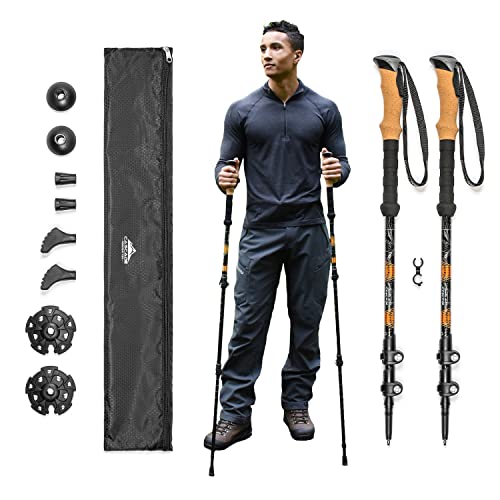
Pros
- Sturdy 6061 aluminum shafts resist bending under load across rocky trails and uneven terrain
- Ergonomic cork handles combined with EVA lower grips provide comfortable, versatile hand positions
- Lever-style quick locks allow fast, tool-free length adjustments between 26 and 54 inches
- Generous accessory bundle includes mud baskets, snow baskets, rubber boots, tip covers, and a carry bag
Cons
- Collapsed length of 26 inches may extend above the top collar of smaller 15L to 20L daypacks
- At 10 ounces per pole, aluminum construction is heavier than ultralight carbon fiber designs
- Quick-lock cam tensioners require occasional thumb-screw checks to maintain firm holding pressure over time
The Cascade Mountain Tech 6061 Aluminum Trekking Poles serve as a dependable, budget-conscious trail accessory designed for day hikers, weekend backpackers, and outdoor walkers seeking upper-body engagement and knee relief. Built to pair with standard hiking daypacks and larger backpacking packs, these two-section adjustable poles provide steady points of contact across varied outdoor surfaces.
On the trail, the quick-lock lever mechanism allows smooth height adjustments spanning from 26 inches up to 54 inches to accommodate various hiker heights and changing slope angles. Weighing approximately 10 ounces per pole, the shafts offer solid balance without excessive swing weight. When you reach a flat trail section or scramble where free hands are required, the poles collapse to a manageable 26-inch profile that fits neatly onto external backpack gear loops, side compression straps, or inside the included travel bag.
Material construction centers on aircraft-grade 6061 aluminum, which provides dependable bend resistance when navigating rocky terrain, boulder fields, or stream crossings. The ergonomic handles combine genuine cork tops with extended EVA down grips. The cork sections help dampen ground vibrations and wick moisture away during warm summer hikes, while the lower foam sections let hikers quickly lower their hand positions during steep switchbacks without pausing to readjust pole length.
Dialing in the poles for specific trails is straightforward thanks to the included accessory bundle. The core shafts feature tungsten carbide tips that bite into hard-packed dirt and slick rock surfaces. For paved greenways or sensitive rock paths, push-on rubber boots and tip covers provide traction and prevent surface scarring. When transitioning to wet spring trails or winter routes, the interchangeable mud and snow baskets screw on easily to prevent the poles from sinking deeply into soft ground.
While these poles provide dependable trail stability, prospective buyers should recognize a few practical design tradeoffs. The three-section telescoping design collapses to 26 inches, which is longer than folding Z-style poles and may extend beyond the top of compact 15-liter to 20-liter daypacks. At roughly 10 ounces per pole, aluminum construction also carries a modest weight penalty compared to premium carbon fiber poles. In addition, the quick-lock cam tensioners may require occasional finger-tightening of the thumbscrews to maintain positive locking force over miles of continuous vibration.
For beginner hikers, weekend backpackers, and budget-conscious outdoor enthusiasts looking for reliable trekking poles with comprehensive multi-season accessories, the Cascade Mountain Tech 6061 Aluminum Trekking Poles offer balanced durability and practical trail support.
When not in use, each pole collapses down to a compact 26 inches, allowing hikers to stow them easily along the exterior of most hiking backpacks. Hikers can thread the tungsten carbide tips through standard lower trekking-pole attachment loops and secure the upper shafts using side compression straps or elastic bungi cords.
For travel or vehicle storage, the set includes a lightweight zippered travel bag that prevents dirt, mud, and trail debris on the baskets and tips from contacting the interior fabric of your backpack or luggage. At 10 ounces per pole, carrying them on your pack adds minimal base weight during trail approaches.
The poles arrive with an extensive accessory package configured for year-round hiking versatility. Hard tungsten carbide tips serve as the baseline contact point for dirt singletrack, loose scree, and rugged mountain paths where maximum purchase is necessary.
For asphalt trails, slick boardwalks, or indoor transit, the included rubber boots and tip covers slip over the metal ends to dampen noise and enhance surface grip. The kit also includes wide rubber snow baskets and medium mud baskets, which prevent the poles from sinking into deep drifts, boggy soil, or loose river gravel.
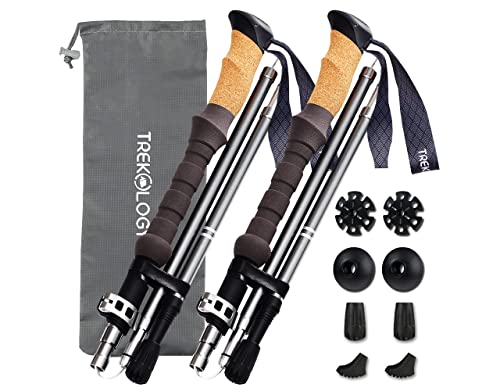
Pros
- Collapses down to a compact 15 inches, fitting easily inside backpacks or carry luggage bags
- Natural cork handles absorb hand perspiration effectively during strenuous hikes
- Sturdy aircraft-grade aluminum construction with protective metal caps at the folding joints
- Simple height adjustment between 110 cm and 130 cm via a sturdy metal flip lock lever
Cons
- TSA regulations require trekking poles to be packed in checked luggage rather than carry-on bags
- Users must verify the push-button lock is fully popped out to ensure shaft stability before hiking
- At 11.5 oz per pole, aluminum construction is heavier than ultralight carbon-fiber alternatives
The Trekology Trek-Z Cork Grip Collapsible Trekking Poles are three-section folding hiking sticks designed for day hikers, backpackers, and adventure travelers who require portable stability on uneven trails. Rather than using traditional telescoping designs that remain long when collapsed, these poles utilize a tri-fold folding cable system that stows down to a compact 15 inches. This makes them a strong match for hikers who prefer storing their poles directly inside a daypack or securing them flat against external pack compression straps without poles protruding past the top lid.
On trail, these poles offer an adjustable length range of 110 cm to 130 cm, covering a stated user height range between 5'2" and 6'5". Each pole weighs 11.5 oz (330 g), delivering a solid feel that helps distribute carried weight and stabilize joint impact on steep descents. The main handle is shaped from natural cork, which naturally absorbs hand moisture and sweat during warm trail outings. Trekology notes that the cork grips incorporate a slight rotational flex as an anti-torque ergonomic feature. Below the cork, secondary EVA foam grips allow hikers to quickly choke down on the poles when negotiating short, steep step-ups without adjusting overall pole length.
Build quality centers on aircraft-grade aluminum alloy shafts, chosen to withstand lateral loads and rocky terrain where brittle materials might crack. To reinforce high-stress connection points, Trekology adds metal caps around the folding joints, reducing play once the poles are deployed. Extension and length adjustments are secured using a durable metal flip lock at the upper section, ensuring reliable clamping power once clamped to the hiker's preferred height marker.
Deploying the poles requires extending the folding sections until the internal tension cable pulls tight and an internal metal lock button pops through the shaft hole. Ensuring this button is fully seated is essential for complete structural rigidity before latching the upper flip lock. For transport, collapsing the poles takes seconds, allowing both poles to slip neatly into the included storage bag. When traveling by commercial air to hiking destinations, keep in mind that TSA and airline policies classify trekking poles as checked luggage, meaning they must be stowed inside checked duffels or backpacks rather than overhead carry-on bags.
While the folding mechanism provides impressive packability, the design does present a few practical limitations. The total adjustment range is 20 cm (110 to 130 cm), which may not suit hikers under 5'2" who require a shorter pole setup. Additionally, at 11.5 oz per pole, weight-conscious thru-hikers aiming for sub-pound base weights might find aluminum folding poles heavier than fixed-length carbon options. The locking button also requires careful initial alignment during assembly to ensure the segments seat properly without wobbling.
For hikers, backpackers, and travelers seeking dependable trail support without spending top-tier outdoor brand prices, the Trekology Trek-Z Cork poles offer exceptional value. The combination of sweat-wicking cork handles, reinforced aluminum joints, and an ultra-packable 15-inch folded size makes them a versatile accessory for everything from local forest walks to rugged mountain backpacking trips.
The Trekology Trek-Z poles adjust between 110 cm and 130 cm in length, accommodating hikers measuring roughly 5'2" to 6'5" (159 to 195 cm) in height. Length adjustments are managed via a metal flip lock clamp on the top shaft section, allowing users to fine-tune height based on trail slope or individual arm ergonomics.
Hikers shorter than 5'2" may find the minimum 110 cm setting too tall for standard 90-degree elbow positioning on level terrain. Always confirm that your forearm rests parallel to the ground when holding the cork grip before clamping the metal flip lock.
Thanks to a three-piece folding design, the Trek-Z poles collapse down to just 15 inches (38 cm) in length. This compact size allows them to fit horizontally or vertically inside most standard daypacks, carry duffels, or luggage cases without hanging loosely off external attachment points.
The poles come with a dedicated carry bag to keep trail mud and dust away from clean gear inside your backpack. Hikers traveling by air should remember that TSA guidelines prohibit trekking poles in carry-on baggage, requiring these poles to travel inside checked luggage.
The pole shafts are manufactured from aircraft-grade aluminum alloy, delivering reliable strength-to-weight performance and high resistance to bending stresses on demanding rocky routes. The connection joints are strengthened with metal caps to guard against joint wear and slippage over time.
The handles feature genuine cork, which helps manage perspiration and adapts comfortably to hand pressure over long miles. A secondary EVA foam grip sits directly beneath the cork for quick hand repositioning on steep gradients without stopping to change shaft length.

Pros
- Folds down to 15 inches, making it significantly easier to pack inside travel luggage or strap to compact daypacks than standard telescoping poles
- Moisture-wicking natural cork handles keep palms dry and comfortable across humid hiking conditions
- Sturdy metal flip locks and reinforced joint caps provide solid structural support without slippage when properly tensioned
- Lower EVA foam grips allow instant trail adjustment for steep uphill climbing
Cons
- At 11.5 ounces per pole, they carry more weight than specialized ultralight carbon fiber poles
- The 110 cm minimum height setting may feel slightly too long for hikers under 5 feet 2 inches
- Per TSA regulations, trekking poles with metal tips must be packed in checked luggage rather than carried on flights
The Trekology Trek-Z Cork Grip Trekking Poles are folding, multi-section hiking sticks designed for hikers, backpackers, and travelers who require sturdy trail stability without the awkward bulk of traditional telescoping poles. Sold as a pair with an included carry bag, these poles suit day hikers tackling uneven paths, weekend backpackers managing load transfer on descents, and outdoor enthusiasts who need compact gear that fits inside travel luggage or standard daypack side sleeves.
Trail packability is one of the standout characteristics of this design. Utilizing a retractable tri-fold cable system, each pole breaks down to just 15 inches (38 cm) in overall length. This short folded dimension lets you slip the pair directly into the main compartment of an overnight pack, tuck them into side stretch-mesh water bottle pockets, or strap them beneath external compression straps without snagging overhead brush. For length adjustment, an upper aluminum section provides a 20 cm sliding range from 110 cm to 130 cm, catering to user heights between 5 feet 2 inches and 6 feet 5 inches.
Component construction focuses on long-term trail durability. Trekology builds the Trek-Z poles from aircraft-grade aluminum alloy, which provides higher impact resistance and flex tolerance against rocky crevices compared to brittle carbon fiber. The folding shaft joints feature protective metal caps to resist wear at stress points during repeated assembly. Up top, the natural cork grip wicks moisture away from sweaty palms during steep ascents, while a secondary EVA foam grip sleeve allows you to lower your hand placement instantly on steep trail grades without adjusting the shaft length.
Deploying and adjusting the poles requires a straightforward two-step setup. After letting the lower segments drop into place, you pull the upper shaft section until an internal metal locking button pops outward with a firm click. A durable metal external flip lock then secures the upper telescoping section at your desired height marker. Proper setup is essential; if the lower shaft feels loose or disconnected, the metal lock button must be firmly pulled until fully seated in its designated catch hole. Maintenance is simple, requiring only an occasional wipe-down with a dry cloth after muddy hikes before packing into the included storage sleeve.
While practical and durable, the Trek-Z design carries a few realistic limitations. Each pole weighs 11.5 ounces (330 grams), resulting in a combined pair weight around 23 ounces, which may deter dedicated ultralight thru-hikers who prefer minimal swing weight. Additionally, the minimum length of 110 cm means youth hikers or adults under 5 feet 2 inches might find the grip positioning too elevated on flat terrain. Travelers should also remember that TSA guidelines require trekking poles with rigid tips to travel inside checked baggage rather than carry-on packs.
For hikers seeking an affordable, compact, and robust set of walking poles, the Trekology Trek-Z Cork Grip poles deliver excellent overall value. They provide dependable joint support, sweat-wicking cork comfort, and pack-friendly folding convenience that fits easily into standard hiking backpacks and travel duffels.
The Trekology Trek-Z poles feature an adjustable working range between 110 cm and 130 cm, making them compatible with users measuring between 5 feet 2 inches and 6 feet 5 inches in height. Sizing adjustments are controlled via a durable metal flip-lock clamp positioned on the upper shaft section, marked with clear centimeter increments for quick alignment.
Hikers can lengthen the poles slightly for steep downhill sections to maintain an upright posture, or shorten them for prolonged uphill climbs. For fast grade transitions where stopping to loosen the clamp is impractical, the extended EVA foam grip below the primary cork handle allows instant choke-down positioning.
Thanks to a three-section folding architecture linked by an internal tension cable, the Trek-Z poles collapse down to an ultra-compact 15 inches (38 cm). This compact footprint allows them to slide vertically inside most 20-liter to 65-liter hiking backpacks, eliminating the tip-heavy snagging hazards common with longer two-piece or three-piece telescoping poles.
A matching carry bag is included to keep trail mud and dust away from sleeping bags, pack liners, and clothing when stored internally. When flying to destination trailheads, note that airline security guidelines require trekking poles to be packed within checked baggage rather than carry-on luggage.
The shafts are manufactured from aircraft-grade aluminum alloy, delivering high tensile strength and resilience against bending forces when supporting heavy backpack loads on rocky trails. The connection joints between segments are reinforced with metal caps to resist cracking and wall deformation under load.
The upper handle utilizes natural cork material that absorbs hand moisture, resisting slick spots during warm summer outings. The handle is engineered with a slight rotational flex that acts as an anti-torque buffer, reducing jarring impacts transmitted through the hands and wrists across prolonged trail miles.
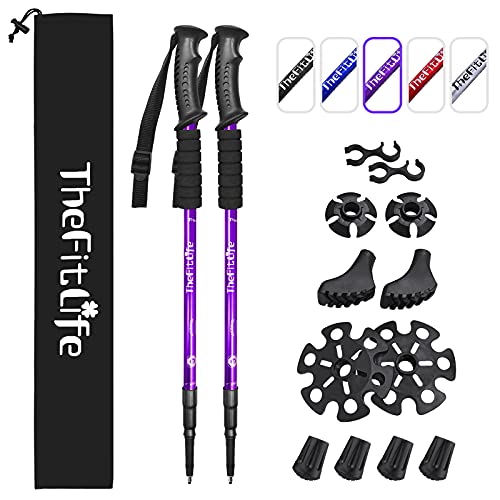
Pros
- Lightweight build at only 9.92 oz per pole reduces arm fatigue on long day hikes and backpacking trips
- Internal anti-shock springs help absorb repeated trail impacts on rocky or downhill terrain
- Includes full set of mud baskets, snow baskets, walking caps, and rubber tips for varied trail surfaces
- Disassembles down to 21.46 inches for practical packing inside standard 22-inch travel luggage
Cons
- Internal twist locks require firm manual tightening compared to external flick-lock levers
- Collapsed length of 25.6 inches may protrude above compact daypacks when lashed to external straps
- Rubber grips offer dependable traction but may feel less breathable on hot, sweaty summer hikes than natural cork
TheFitLife Telescopic Trekking Poles are adjustable three-section aluminum hiking sticks designed for day hikers, weekend backpackers, fitness walkers, and travelers who need reliable balance assistance on the trail. Weighing just 9.92 ounces (282 grams) per pole, this set adds minimal weight when strapped to a backpack while offering structural stability for ascending steep inclines and navigating uneven terrain.
Built to accommodate a broad range of user heights, each pole extends from 25.6 inches (65 cm) up to 51.2 inches (130 cm). The internal anti-shock spring system is engineered to dampen trail vibrations each time the pole plants on hard rock or packed dirt. This subtle cushioning effect is particularly helpful during long descents where repetitive shock transfers directly into the wrists, elbows, and knees.
The shafts are constructed from high-strength aluminum alloy, balancing impact resistance with fatigue durability on rocky paths. Rather than using external clamp levers that can catch on underbrush or gear webbing, TheFitLife utilizes a refined internal twist-lock system. It tightens securely with a simple twist, maintaining a streamlined profile that is easy to operate even while wearing trail gloves. Ergonomic non-slip rubber grips provide a firm and comfortable hold throughout changing weather.
Packing and trail transport are straightforward. Outdoor hikers can secure the poles externally using backpack gear loops and compression straps at their collapsed length of 25.6 inches. For travelers packing for distant trailheads, the poles separate completely into three sections measuring 21.46 inches (54.5 cm), allowing them to fit diagonally inside most standard 22-inch or larger travel suitcases. The package also includes mud baskets, snow baskets, protective rubber tips, and walking caps to handle mud, scree, snow, or paved paths.
A realistic consideration is the twist-lock design itself. While it eliminates bulky external hardware, twist mechanisms require deliberate tightening to prevent slipping under heavy vertical pressure, which can be harder to gauge in freezing weather compared to quick-cam levers. Additionally, hikers using small daypacks under 20 liters may find the 25.6-inch collapsed length slightly tall when mounted to smaller exterior pack pockets.
For recreational day hikers, entry-level backpackers, and fitness walkers seeking reliable trail support at a budget-conscious price point, TheFitLife Telescopic Trekking Poles offer strong value. Their combination of joint-cushioning anti-shock springs, solid aluminum durability, and comprehensive seasonal attachments makes them a versatile companion for trails across the country.
TheFitLife Trekking Poles offer a versatile length adjustment range spanning from 25.6 inches (65 cm) to 51.2 inches (130 cm). This broad range allows men, women, teenagers, and seniors to set an optimal pole height that maintains an efficient 90-degree elbow bend on flat terrain.
Height adjustments are controlled by twisting the telescoping sections. Hikers can shorten the shafts during steep uphill climbs to maintain forward momentum or lengthen them on descents to improve balance and stability across rough trail sections.
When hiking with a daypack or backpacking pack, these poles can be secured externally to trekking-pole loops, daisy chains, or side compression straps. Their collapsed profile of 25.6 inches sits comfortably alongside standard 30 to 65-liter backpacks without excessive overhang.
For air travel or off-season storage, the three aluminum sections can be separated entirely. In this disassembled state, the longest section measures 21.46 inches (54.5 cm), making the set compact enough to fit diagonally within most 22-inch or larger luggage bags.
TheFitLife provides a multi-terrain accessory kit with every pair. Included are rubber tips for hard rock surfaces, walking caps designed for paved surfaces and fitness walking, mud baskets to prevent poles from sinking into soft soil, and broader snow baskets for winter trail use.
All included attachments screw on and off quickly in the field without tools. This modular system allows hikers to adapt the poles seamlessly whether navigating muddy spring switchbacks or paved park trails.
How to Determine the Right Hiking Stick Size for Your Body and Trail Terrain
Finding the correct hiking stick size transforms a simple piece of outdoor gear into an effective balance stabilizer and joint-relief tool. Selecting an improper shaft length leads to hunched posture, shoulder fatigue, and unsteady foot placement across challenging trail surfaces. By evaluating your standing height, trail footwear, terrain slope, and grip style, you can establish an accurate measurement that protects your body throughout long days on the trail.
The Standard Ninety-Degree Elbow Measurement Rule
The universal baseline for sizing any walking stick begins with your standing posture on a flat, even surface. Put on the specific trail shoes or hiking boots you plan to wear outdoors, because aggressive lugs and thick cushioned midsoles can add an inch or more to your standing height. Stand tall with your shoulders relaxed, chest open, and upper arms resting naturally alongside your torso. Bend your active elbow forward until your forearm aligns parallel to the floor, creating an exact right angle of ninety degrees at the elbow joint. The vertical measurement from the ground to the center of your palm represents your optimal standard stick height for level terrain.
This ninety-degree arm posture keeps your wrist in a neutral position and minimizes muscular tension across your forearms, biceps, and trapezius. If the stick is sized too tall, your elbow closes into an acute angle, forcing your shoulder to hitch upward with every forward plant. That persistent shoulder lift causes neck fatigue and upper-back stiffness over several miles of trail walking. Conversely, a stick that rests too low causes you to stoop forward, placing unnecessary strain on your lumbar spine and shifting your balance uncomfortably forward. Maintaining a level forearm establishes an efficient mechanical lever that directs downward pressure smoothly through the shaft into the earth.
Sizing Traditional Shoulder and Chest-Height Hiking Staffs
While modern walking sticks rely strictly on the ninety-degree forearm rule, traditional single-piece hiking staffs follow a completely different sizing philosophy. Handcrafted wooden staffs made from resilient hardwoods such as hickory, oak, sweet chestnut, or hazel typically measure between fifty and fifty-five inches in overall length. When stood vertically on level ground, a staff of this length reaches between your armpit and your chin. This generous vertical height provides specialized balance utility across unpredictable backcountry terrain where trail gradients change continuously.
A chest-height staff allows you to vary your grip position along the natural grain without stopping to adjust mechanical hardware. When ascending steep boulder fields or muddy banks, you can choke your grip down toward the center of the staff to generate forward propulsion without lifting your hands above your shoulders. When descending steep trail steps, you can place your palm flat across the rounded top knob to steady your footing from an upright stance. This multi-level hand positioning makes taller wooden staffs exceptionally practical for navigating rocky river crossings, probing deep leaf litter, and balancing along rugged wilderness trails.
Height Guidelines and Sizing Reference by User Height
Consulting a standardized sizing chart offers a helpful starting point when selecting adjustable poles or purchasing a fixed-length staff online. Walkers standing between five feet and five feet four inches tall generally achieve proper balance with a stick adjusted between forty and forty-four inches (one hundred to one hundred ten centimeters). Hikers measuring between five feet five inches and five feet eight inches typically require a stick length between forty-four and forty-eight inches (one hundred ten to one hundred twenty centimeters). Individuals between five feet nine inches and six feet tall usually set their gear between forty-eight and fifty-two inches (one hundred twenty to one hundred thirty centimeters). Hikers standing over six feet tall generally need lengths extending between fifty-two and fifty-four inches (one hundred thirty to one hundred thirty-seven centimeters).
Adjustable trekking poles typically feature etched centimeter and inch increment markings along the lower shaft sections to simplify initial setup. Models like the TrailBuddy Trekking Poles offer a versatile adjustment range between twenty-four and a half inches and fifty-four inches, making them adaptable for youth hikers, seniors, and tall adults alike. Similarly, Cascade Mountain Tech Trekking Poles expand smoothly from twenty-six inches to fifty-four inches using external quick locks. When setting multi-section poles, extend each adjustable segment equally to the corresponding numbered line so the shaft distributes mechanical load evenly throughout its joints.
Adjusting Stick Length for Steep Uphill and Downhill Gradients
Mountain trails rarely remain level, meaning your flat-ground measurement must adapt as slopes become steeper. When you hike up a steep incline, the ground rises in front of you, naturally reducing the distance between your hands and the trail surface. Keeping your sticks at their standard flat-ground length forces you to raise your hands toward your chest with every forward plant. Shortening each pole by two to three inches (five to eight centimeters) keeps your forearms level, prevents shoulder fatigue, and lets you push downward effectively to assist your leg drive.
Descending a steep trail reverses this mechanical challenge because the ground falls away sharply beneath your feet. Lengthening your hiking sticks by two to three inches enables you to plant the tips securely downhill before stepping forward. This extended reach provides an early point of contact that absorbs braking forces and offloads substantial impact from your quadriceps and patellar tendons. If you walk with a fixed-length wooden staff that cannot be physically extended, palming the top knob or resting your palm over a derby handle gives you that vital downhill reach without causing you to bend at the waist.
Grip Ergonomics, Extended Sleeves, and Hand Fatigue
Handle design and grip placement directly impact how your hands, wrists, and forearms interact with the stick over prolonged distances. Traditional wooden sticks feature carved knobs, derby handles, or classic tourist crooks that distribute downward palm pressure across a broad wooden surface. Modern poles frequently incorporate natural cork grips that wick sweat away from your skin while molding to the unique shape of your fingers over time. The Trekology Trek-Z poles feature ergonomic cork handles engineered with subtle rotational flex, which helps dissipate trail torque and relieves wrist strain across rocky paths.
In addition to primary handles, extended down-grips made from ribbed EVA foam deliver outstanding versatility across rolling trail terrain. The Cascade Mountain Tech poles include an extended EVA sleeve situated right below the main cork grip. This lower grip zone allows you to drop your hand placement several inches lower on sudden uphill switchbacks without loosening hardware to re-adjust pole length. Once the trail levels out, you simply return your hand to the upper cork handle, preserving energy and maintaining your walking cadence.
Shaft Mechanisms: Lever Locks, Twist Collars, and Folding Poles
The locking mechanism responsible for securing your stick height dictates both trail durability and adjustment convenience. External lever locks, found on models from TrailBuddy and Cascade Mountain Tech, utilize cam-action clamps that can be operated quickly even when wearing thick winter gloves. A textured thumb dial allows you to calibrate clamping tension so the shaft remains rock solid under heavy downward loads. Regularly checking this tension screw prevents unexpected shaft collapse when descending over rough granite boulders or uneven tree roots.
Twist-lock systems, such as those on TheFitLife Telescopic Trekking Poles, rely on internal expanding expanders inside the aluminum tubing to produce a sleek exterior shaft free from external catches. While twist locks offer a clean profile and incorporate internal anti-shock springs to cushion joint impacts, they require firm hand torque to lock securely in wet conditions. Collapsible Z-pole designs, like the Trekology Trek-Z, use an internal tension cord and push-button pin to fold down to just fifteen inches. These compact folding sticks pack neatly into luggage following a carry-on backpack packing guide, though their total adjustment range is typically limited to twenty centimeters via an upper lever clamp.
Ground Traction: Rubber Ferrules Versus Carbide Trail Spikes
Tip selection significantly influences ground traction and effectively changes the working height of your stick on diverse surfaces. Most trail poles feature durable tungsten carbide or hardened steel tips engineered to bite into loose dirt, forest loam, gravel, and packed ice. However, bare metal spikes slide unpredictably on smooth rock slabs, asphalt walkways, and polished indoor tile, presenting a serious falling hazard. Knowing when to swap your tip accessories ensures reliable footing while protecting the integrity of both your gear and the trail surface.
Slip-on rubber ferrules and walking caps provide essential friction across hard pavement, bedrock, and wooden bridges while preventing metal spikes from gouging sensitive terrain. Quality rubber ferrules feature an embedded metal washer at the base of the internal socket to prevent the pointed metal tip from puncturing the rubber under heavy weight. When hiking across marshy ground or deep snow, threading on mud or snow baskets stops the stick from sinking excessively into soft ground. Storing your spare rubber boots and baskets in a designated pocket of your budget-friendly hiking daypack lets you adapt your tip hardware as soon as trail conditions shift.
Common Sizing Mistakes and Posture Checks Before Heading Out
One common mistake hikers make is measuring their ideal stick length indoors while standing barefoot or in flat slippers. Omitting the rugged footwear you actually hike in can introduce a sizing discrepancy of an inch or more, resulting in compromised shoulder mechanics on the trail. Another frequent misstep is sizing a stick strictly for flat terrain while planning a hike with thousands of feet of elevation change. Neglecting to plan for slope variations leaves hikers unprepared to shorten their poles on steep climbs or lengthen them for knee-friendly descents.
Always verify the structural stability and height settings of your walking stick before trusting your weight to it in the field. Place your hands firmly on the grips on a flat surface and press down with steady force to ensure the cam levers or twist locks do not slip. Keep in mind that recreational walking sticks and trekking poles are balance-assist tools intended to stabilize your cadence and reduce joint fatigue, not certified medical mobility devices for non-weight-bearing recovery. Checking your shaft locks, inspecting rubber tips for wear, and dialing in your ninety-degree elbow bend will ensure dependable support on every outdoor trek.




Write Your Review
No reviews yet. Be the first to share your experience!